From Raw Steel to Precision Frame — The Rack Welding Stage
The welding stage of custom automotive parts rack production — where raw steel becomes a precision frame, and where a rack's strength and dimensional accuracy are actually built in.
A close look at the welding stage of custom automotive parts racks, where raw steel becomes a precision frame — the step that decides a rack's strength, dimensional accuracy and long-term durability before grinding and coating.
Every reliable automotive parts rack starts with a strong foundation, and this video shows where that foundation is built: the welding stage, where raw steel becomes a precision frame. Grinding, powder coating and final assembly come next, but the strength, squareness and durability of a rack are decided here, at the first weld.
Why the weld decides the rack
A rack is only as good as its joints. Full, consistent welds let the frame carry its rated load without flexing over thousands of cycles, and welding on fixtures keeps the frame dimensionally accurate so parts seat correctly and loaded racks stack square. A weak or inaccurate weld cannot be fixed by any amount of finishing downstream — which is why this stage gets the attention it does.
Built for load, engineered for the part
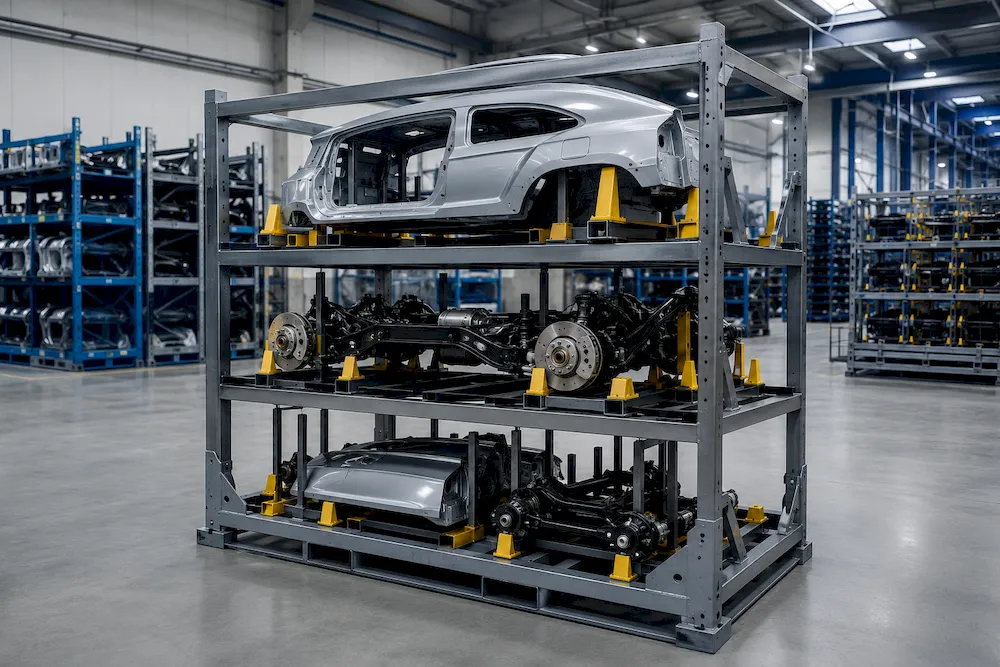
The frame is welded around the specific part it will carry — its weight, its contact points and how the racks will stack. The engineering behind that is covered in our automotive parts rack design guide, and how welded structures are rated for static, dynamic and stacking loads is explained in our load-capacity guide.
Quality from the first weld
Weld quality is verified at final inspection under our ISO 9001:2015 quality system, and grinding smooths every weld so there are no sharp edges to snag hands or scratch parts. Because we weld in-house to your drawings, the structure is built to your specification — see how OEM and ODM work in our sourcing guide.
Explore our automotive parts racks and steel pallets, or send us your drawings for a rack fabricated to your load and part.
Frequently Asked Questions
- Why is welding the most important stage in rack fabrication?
- Welding is where a rack's strength and dimensional accuracy are built in. Full, consistent welds let the frame carry its rated load without flexing, and accurate fixturing keeps the frame square so parts fit and racks stack. Everything after — grinding, coating, assembly — is finishing a structure that the welding stage has already made or broken.
- How do you ensure weld quality on the racks?
- Frames are welded on fixtures to hold dimensions, welds are laid full and consistent for load-bearing joints, and weld quality is checked at final inspection under our ISO 9001:2015 quality system. Grinding then smooths the welds so there are no sharp edges to snag or scratch.
- What happens after the welding stage?
- After welding, frames move through grinding and deburring, then powder coating or paint for corrosion resistance, then final assembly and inspection. Welding builds the structure; the later stages finish and protect it — see our finishing video for that side of the line.
- Do you weld to custom designs?
- Yes. We fabricate racks to your part drawings and load requirements — engineering the frame, fixturing it and welding it to your specification, then load-testing a sample before volume production.