Steel Pallet Load Capacity: Static, Dynamic & Racking Loads Explained

A steel pallet has three load ratings: static (resting on the floor, the highest), dynamic (while being moved, the middle) and racking (supported only at two edges on beams, the lowest). If you store on beam racking, specify to the racking load.
When a supplier quotes a steel pallet load capacity, always ask "which load?" A pallet has three separate ratings — static, dynamic and racking — and they can differ by several times. Buying to the wrong one is how pallets sag on beam racking or fail in a forklift. Here is what each means and how to specify the right one.
Quick answer: which load rating
Ask "which load?" — a steel pallet carries three separate ratings. The static rating (resting on a flat floor) is highest, the dynamic rating (while being moved by forklift or jack) sits in the middle, and the racking rating (supported only at two edges on beams) is lowest. If you store on beam racking, specify to the racking figure.
The three load ratings
| Rating | Meaning | Typically the… |
|---|---|---|
| Static load | Max weight when the pallet sits on a solid, flat floor (or stacked, evenly supported) | Highest number |
| Dynamic load | Max weight while being moved by forklift or pallet jack | Middle number |
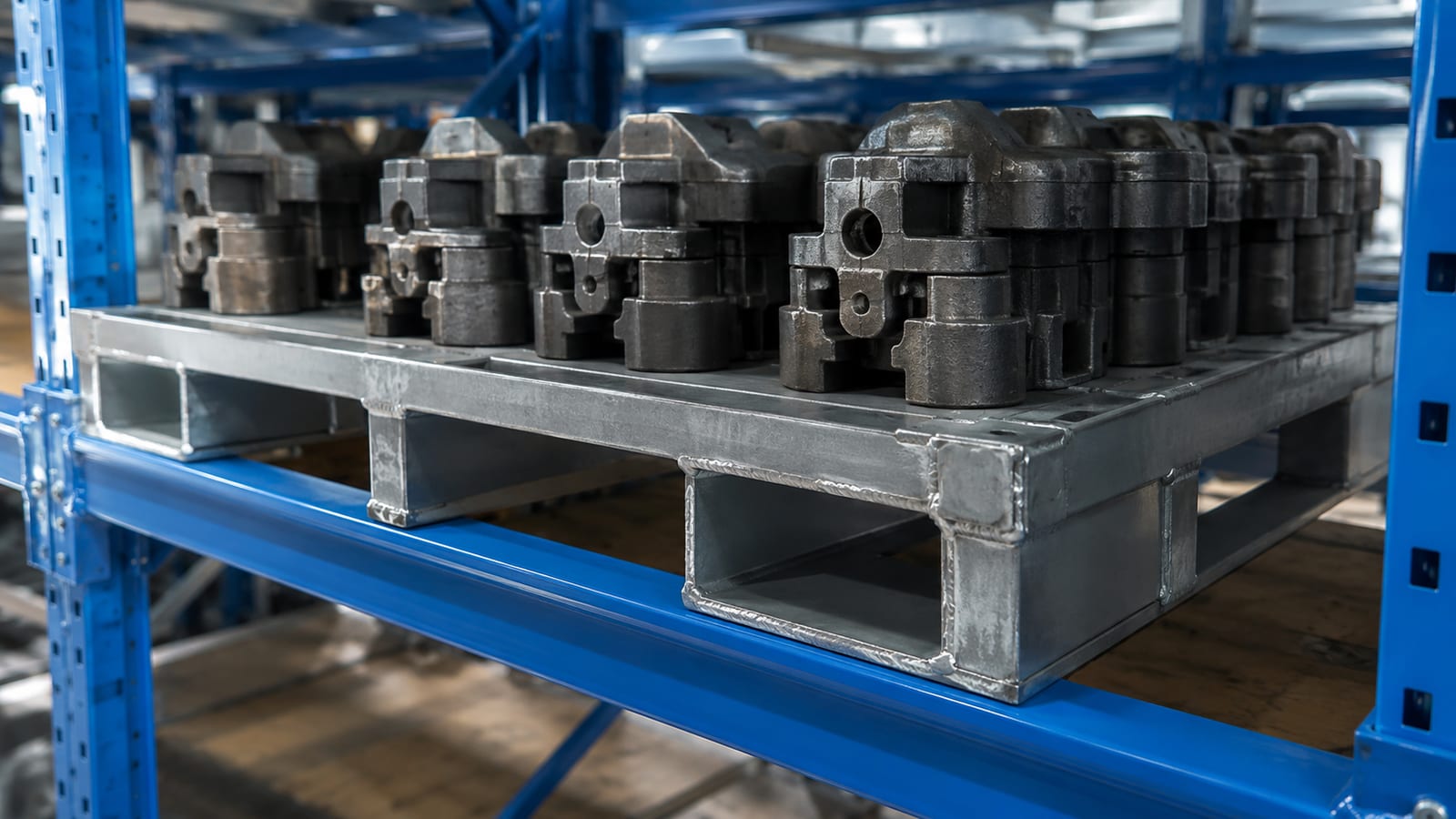
| Racking load | Max weight when supported only at two edges on beam racking (unsupported span) | Lowest — the critical one |
As a rough guide a heavy-duty steel pallet may carry several thousand kg static, ~1,500–2,000 kg dynamic and ~1,000–1,500 kg racking — but the exact figures depend entirely on the design, so treat these as illustration only.
Why racking load is the one that catches buyers out
On the floor a pallet is supported underneath across its whole footprint. On beam racking it is supported only at two edges, so the deck must bridge an unsupported span without excessive deflection. That is why the racking rating is the lowest — and why a pallet rated for your floor load can still sag on the rack. If you store on beams, specify to the racking load.
How load capacity is tested
Reputable pallets are rated using recognised test methods — internationally, pallet performance is covered by ISO 8611 (test methods for flat pallets). Safe handling of the loaded pallet should also follow OSHA materials-handling practice. We build and physically load-test a sample before mass production.
How to specify correctly
- State the load weight and its distribution (point loads are harsher than uniform).
- Say how it's stored — floor stacked, block stacked or on beam racking.
- Design to the governing (usually racking) load, with a safety margin.
- Confirm the rating with a load test, not just a spec sheet.
Get the right steel pallet
HAOFU engineers each steel pallet to your load and storage method, then load-tests it. Send us your load and racking details and we will spec and test the right rating.
Frequently Asked Questions
- What is the difference between static, dynamic and racking load?
- Static load is the maximum weight when the pallet sits on a flat floor; dynamic load is the maximum while it is being moved by a forklift or pallet jack; racking load is the maximum when it is supported only at two edges on beam racking. Static is highest, racking is lowest.
- Why is a steel pallet's racking load lower than its static load?
- On the floor the pallet is supported across its whole underside, but on beam racking it is supported only at two edges and must bridge an unsupported span without sagging. That makes the racking rating the lowest and, for racked storage, the one you must design to.
- How much weight can a steel pallet hold?
- It depends entirely on the design. As rough guidance a heavy-duty steel pallet may carry several thousand kg static, around 1,500–2,000 kg dynamic and around 1,000–1,500 kg racking — but the real figures come from the specific engineering and a load test, so always confirm the rating for your pallet.
- How is steel pallet load capacity tested?
- Pallet performance is evaluated using recognised methods such as ISO 8611 (test methods for flat pallets). We build and physically load-test a sample to the governing rating before mass production, rather than relying on a spec sheet alone.
- Does load distribution affect a steel pallet's capacity?
- Yes. A concentrated point load is harsher on the deck than the same weight spread uniformly, so how the load sits matters as much as how much it weighs. When specifying a steel pallet, state both the load weight and its distribution, say how it is stored, then design to the governing rating with a safety margin and confirm it with a load test.