
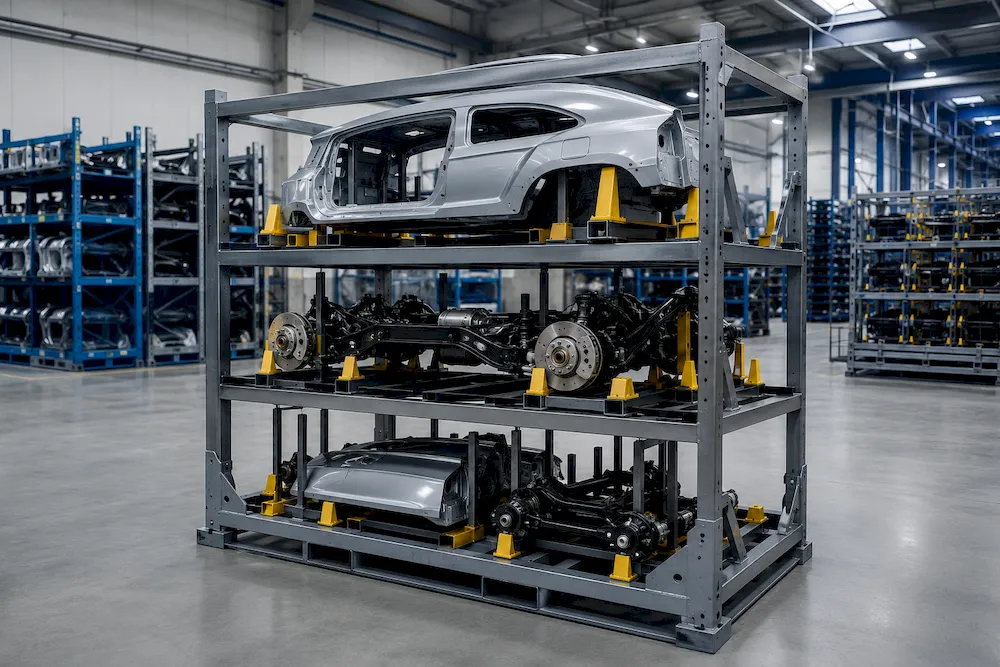
Automotive Parts Racks
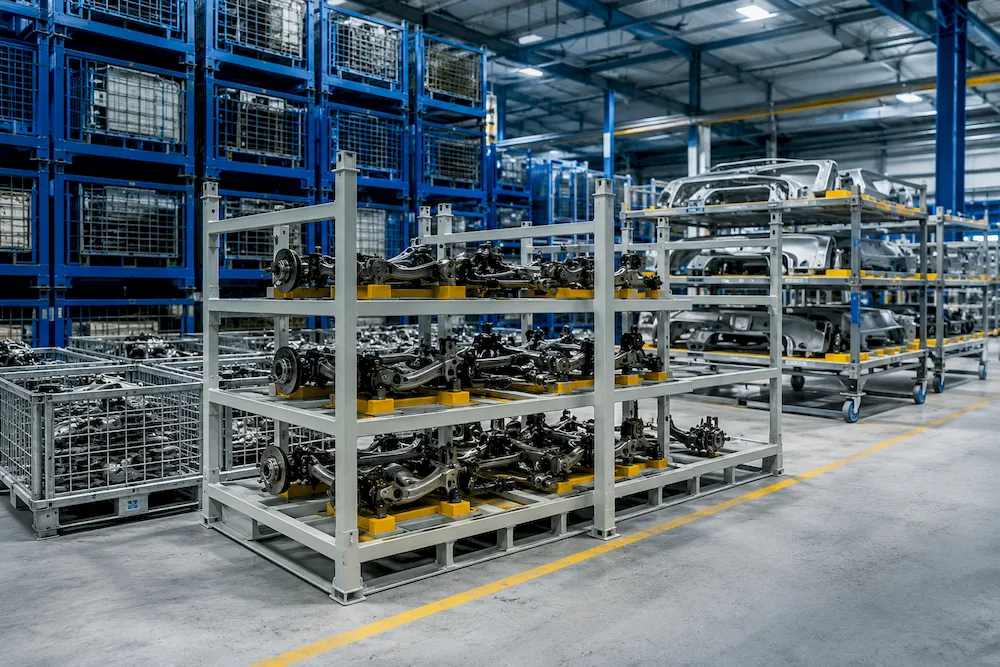
Automotive Parts Racks are designed for the storage, handling, and transport of vehicle components in factories, warehouses, and assembly plants. Each rack can be customized according to the size, shape, weight, and contact points of the parts. The racks help keep components in position during movement and storage. They can be used for car doors, body panels, bumpers, glass, seats, axles, engine parts, battery components, and other automotive parts.
At a Glance
- Material
- Welded steel frame (Q235 or custom grade)
- Load capacity
- 200–2,000 kg per rack (designed to your parts)
- Finish
- Powder coating, paint or galvanizing, with EVA / rubber part protection
- Customization
- Full OEM / ODM — built to your part drawings
- MOQ
- Typically 20–50 units; trial orders available
- Lead time
- Sample 7–15 days; production 4–8 weeks
- Best for
- Doors, panels, bumpers, glass, seats, engine & EV battery parts
Description
Our Automotive Parts Racks use welded steel frames and part support systems to meet different handling needs. Plastic blocks, rubber pads, dividers, straps, and locking bars can be added to protect the parts and reduce movement during transport.
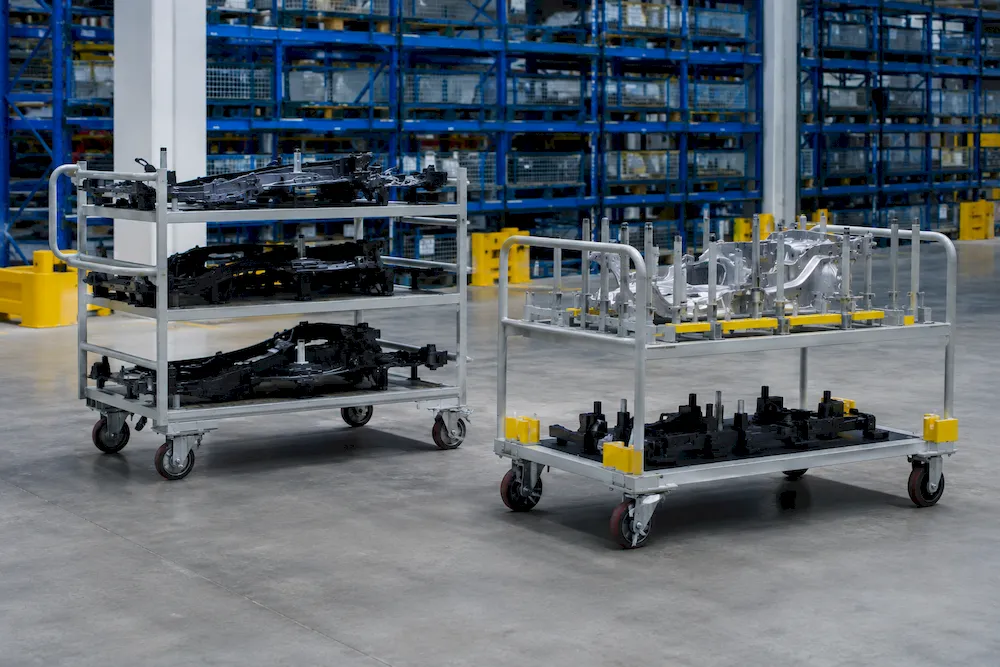
The rack structure can be designed for manual handling, forklift handling, or production-line use. According to the factory process, the rack can include wheels, handles, brakes, forklift pockets, doors, shelves, covers, and identification plates.
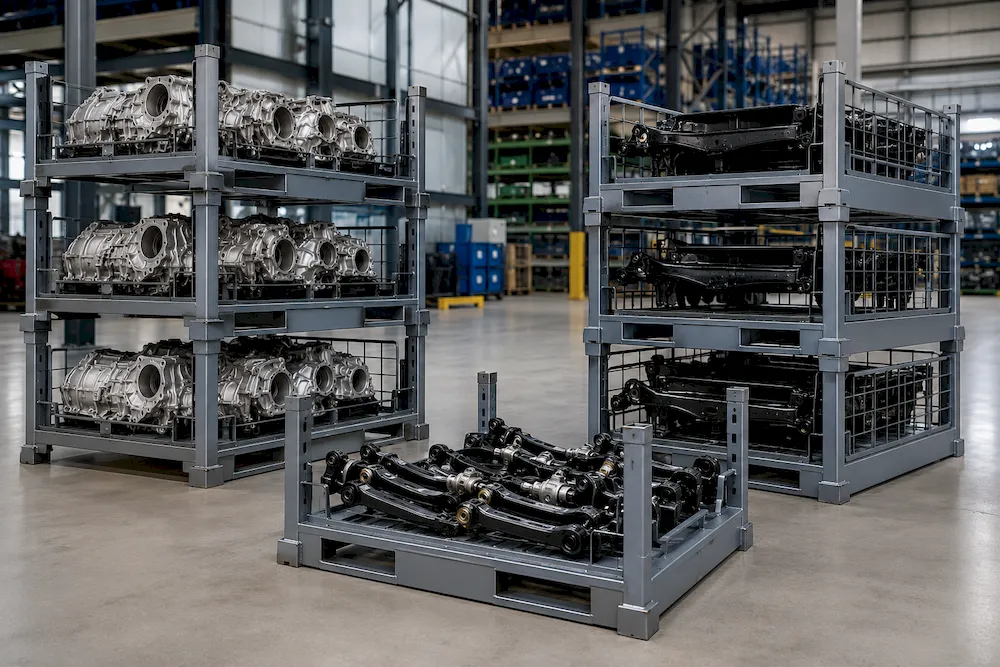
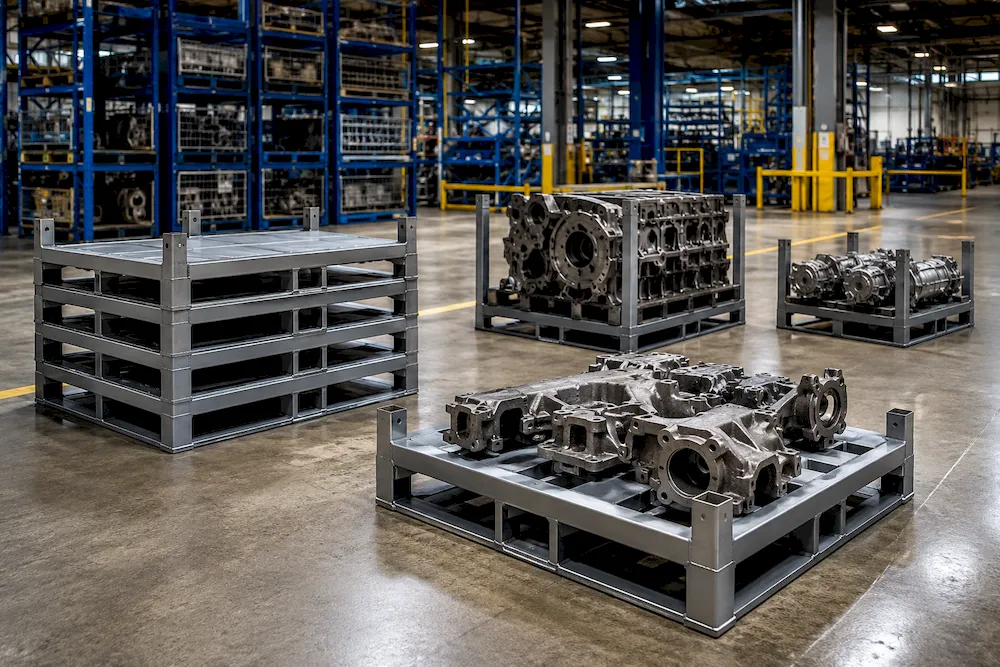
Stackable structures help reduce warehouse floor use. Foldable structures can reduce the space required for return transport when the racks are empty. The surface can be finished with powder coating, paint, or galvanizing according to the use environment.
Each rack can be developed based on customer drawings, part samples, photos, load requirements, and factory conditions.
Main Features
- Custom dimensions and structure
- Designed around part contact points
- Plastic and rubber protection options
- Wheels and forklift pockets available
- Stackable or foldable designs
- Support for different load capacities
- Powder-coated or galvanized finish
- Suitable for repeated transport cycles
Common Applications
- Car door storage and transport
- Body panel handling
- Bumper storage
- Automotive glass transport
- Seat and interior part handling
- Engine and transmission part storage
- Axle and suspension component transport
- Battery and electric vehicle part handling
Customization Information
To develop a rack for your project, please provide:
- Part drawings or photos
- Part dimensions and weight
- Quantity of parts per rack
- Required rack quantity
- Handling method
- Load capacity
- Stacking or folding requirements
- Surface treatment
- Factory and transport space limits
Related Products
Guides & Resources
Learn more about choosing and using automotive parts racks.
Automotive Parts Racks — Frequently Asked Questions
What is the minimum order quantity (MOQ) for automotive parts racks?+
Our typical MOQ is 20–50 racks. Because every rack is custom-engineered to your parts, we can also accept smaller trial orders so you can validate the design before committing to volume — tell us your target quantity and we will confirm feasibility and pricing.
What is the lead time for a custom automotive parts rack?+
After you approve the design we build a sample in about 7–15 days. Once the sample is confirmed, mass production usually takes 4–8 weeks depending on quantity, surface finish and complexity.
What material and surface finish do you use?+
Racks use welded steel frames sized to your load, finished with powder coating, paint, electro-galvanizing or hot-dip galvanizing depending on indoor or outdoor use. Plastic blocks, rubber pads and EVA cushioning protect parts at the contact points.
Can you build racks to my own part drawings or samples?+
Yes. Send your part drawings, photos or samples plus part weight, quantity per rack and handling method (forklift, manual or line-side), and our engineers design the rack around your parts, then refine it after a sample test.
How are the racks packed and shipped for export?+
Racks are designed to be stackable or foldable to save container space and are protected for sea freight. We support FOB and CIF terms, work with your freight forwarder, and provide packing details that maximize the number of units per container to lower freight cost.
Ready to Improve Your Material Handling?
Tell us your requirements and our engineers will contact you within 24 hours.
Contact Us Now