Automotive Mold Storage Rack with 360° Ball Transfer Units
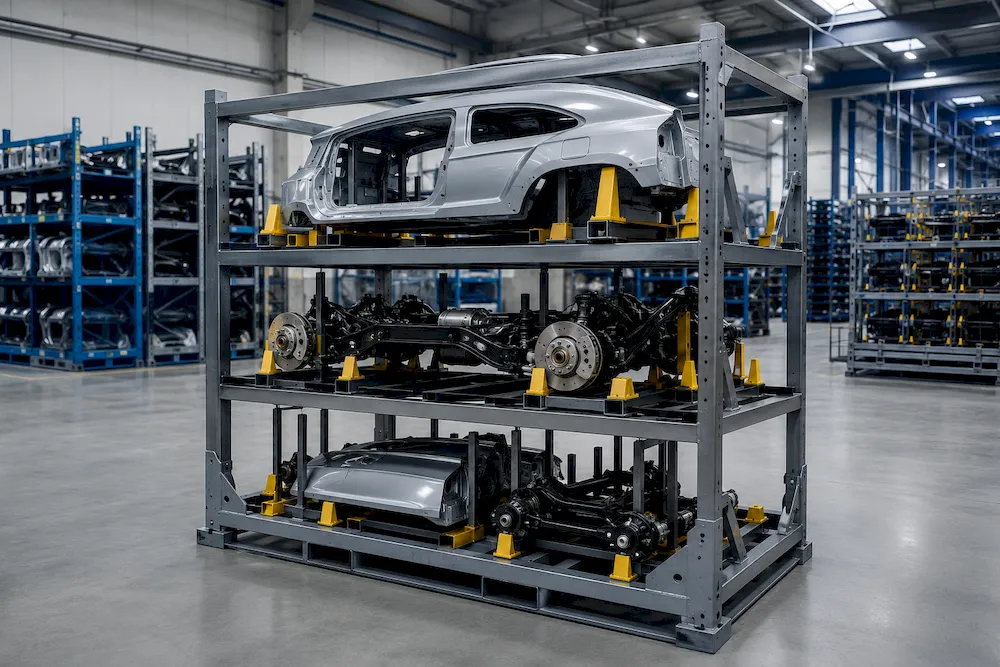
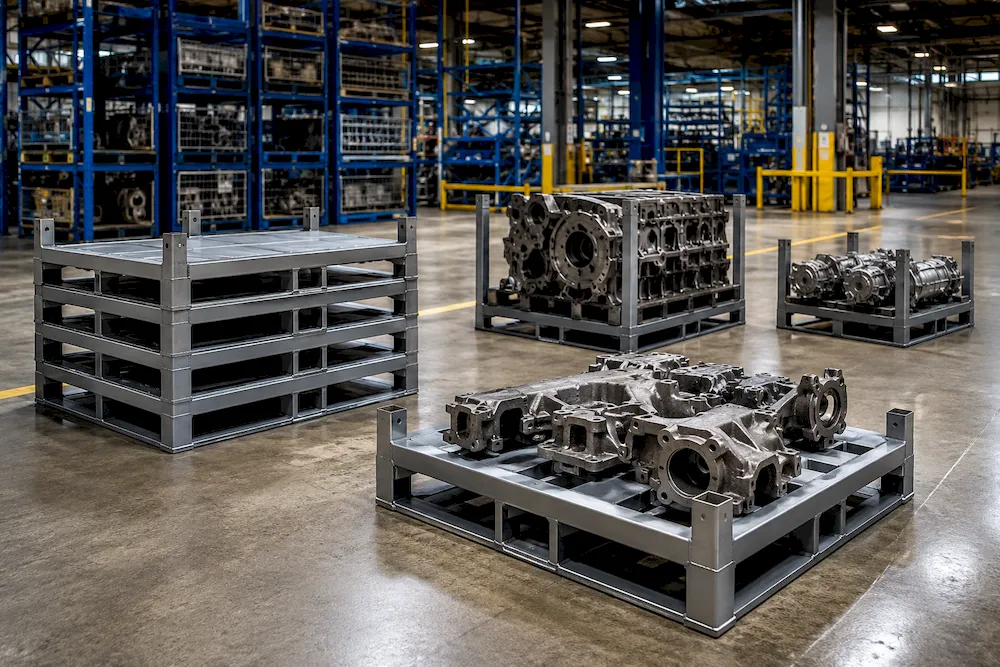
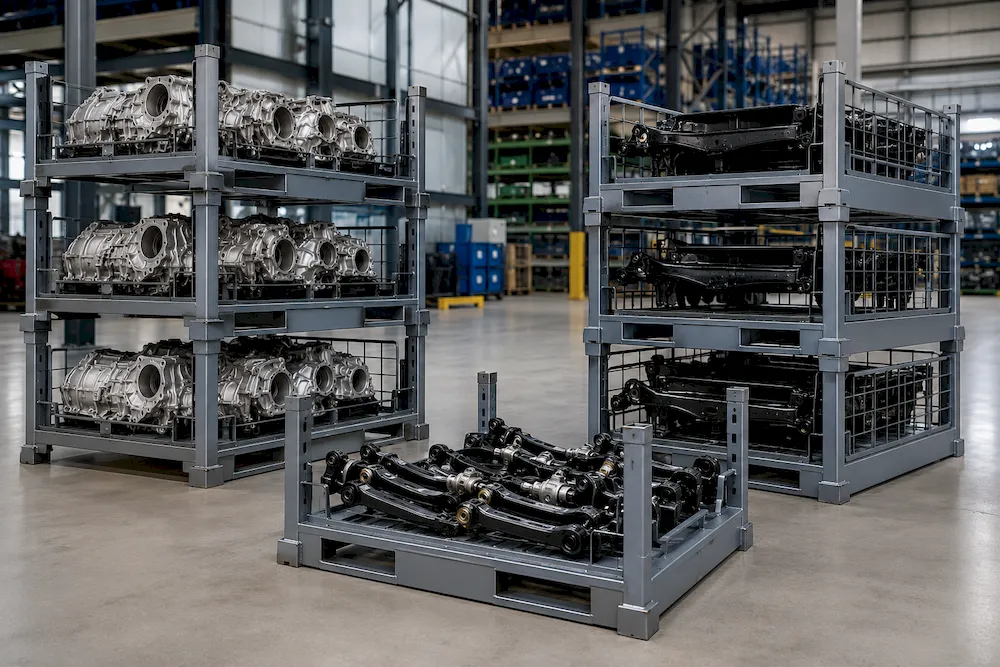
A heavy-duty automotive mold storage rack with 360° ball transfer units on the deck — molds move smoothly during loading and unloading, on a steel structure built for heavy-duty use.
This heavy-duty mold storage rack carries 360° ball transfer units (bullseye casters) on its surface so heavy automotive molds slide smoothly during loading and unloading, on a strong steel structure that keeps molds organised and saves storage space.
This heavy-duty mold storage rack is designed for automotive manufacturing and features 360° ball transfer units — bullseye casters — set into the deck surface, so molds move smoothly and easily during loading and unloading. A strong steel structure carries the concentrated weight, keeps molds organised and saves storage space.
The problem with moving heavy molds
A mold or die is dense, concentrates its mass on a small footprint, and is expensive to repair. Dragging one across a fixed steel deck scores both the mold base and the rack, and it takes several people or a crane to reposition. Ball transfer units turn the deck into a low-friction surface so one operator can slide a heavy mold into place by hand.
Fixed deck vs ball transfer deck
| Factor | Fixed steel deck | Ball transfer deck |
|---|---|---|
| Loading effort | Drag or crane every time | One operator slides the mold in |
| Surface damage | Scores the mold base and deck | Rolling contact, no scoring |
| Positioning | Hard to adjust once landed | 360° movement to fine-tune position |
| Cycle time | Slow, often needs two people | Faster single-operator handling |
| Structure | Simple frame | Frame sized for concentrated point loads |
Sizing the structure to the load
Ball transfer units concentrate the mold's weight into many small points, so the deck and frame have to be engineered for that point loading rather than a spread load. We calculate the loaded and stacked case and validate it on the sample — the same method set out in our load capacity guide. Structural consistency of this kind is part of the ISO 9001 system HAOFU operates to, and safe handling of heavy loads follows OSHA materials-handling guidance.
Keeping the tool room organised
Giving every mold a defined, labelled position turns a crowded tool room into a searchable store. Pair the racks with clear identification — see rack identification and labelling.
Need a better way to store and handle your molds?
We specialise in custom metal racks and material handling solutions for automotive manufacturers. Explore custom racks and steel pallets, or tell us your mold sizes and weights for a customised design.
Frequently Asked Questions
- What is a ball transfer unit on a mold rack?
- A ball transfer unit — also called a bullseye caster — is a load-bearing ball set into the deck surface that rotates freely in every direction. A grid of them turns the rack deck into a low-friction surface, so a heavy mold can be slid and positioned by hand instead of dragged or craned.
- How heavy a mold can the rack take?
- Capacity is engineered per project from the mold's weight and base dimensions. Because ball transfer units concentrate load into many small points, the deck and frame are sized for that point loading rather than a spread load, then validated with a physical load test on the sample.
- Does a ball transfer deck damage the mold base?
- No — the opposite. Rolling contact replaces the sliding friction that scores both the mold base and a fixed steel deck. Unit spacing is set so the base is always supported by several balls at once and never bridges an unsupported gap.
- Can mold racks be stacked or racked?
- They can be built either as free-standing stackable units or as inserts for existing pallet racking, depending on your tool room layout and ceiling height. Tell us which you need and we size the frame and stacking feet accordingly.
- Can you build racks for our existing mold sizes?
- Yes. Send the mold dimensions, weights and how you currently load them — by crane, forklift or by hand — and we design the deck grid, frame and access around that. We build and load-test a sample before mass production.