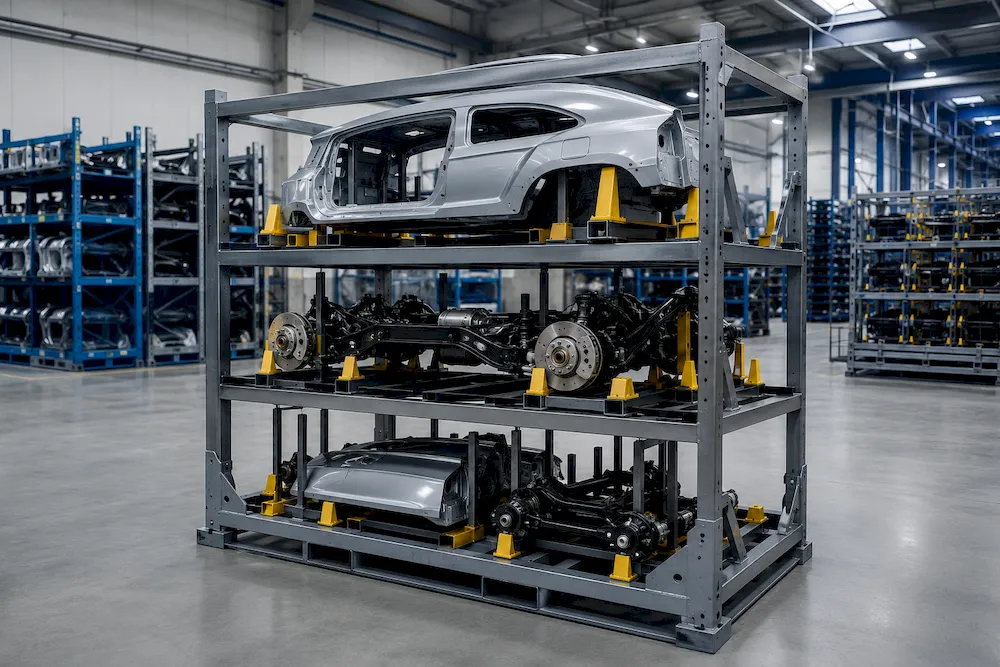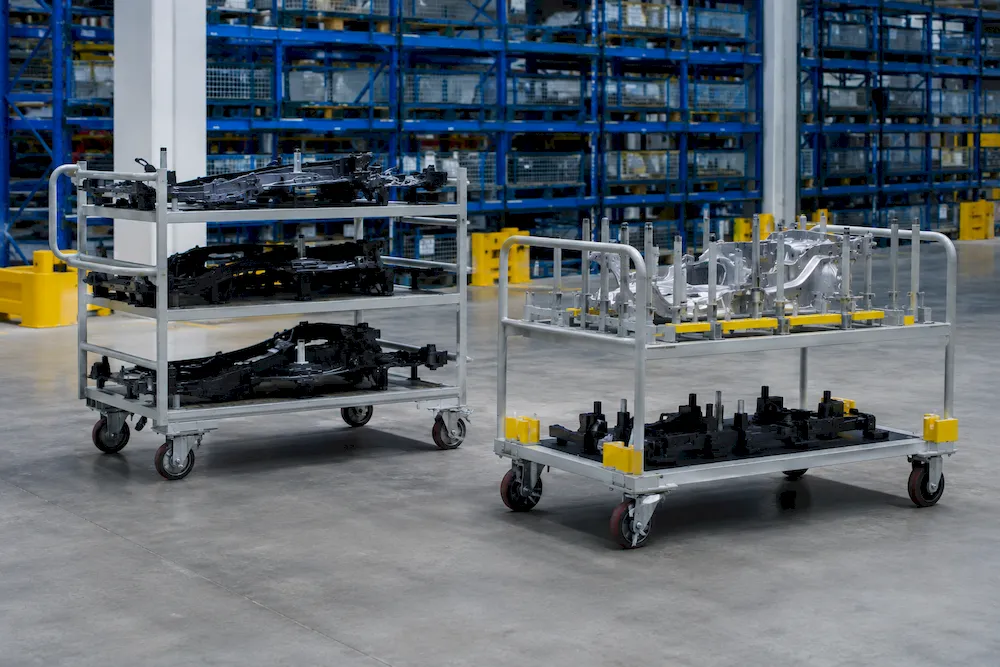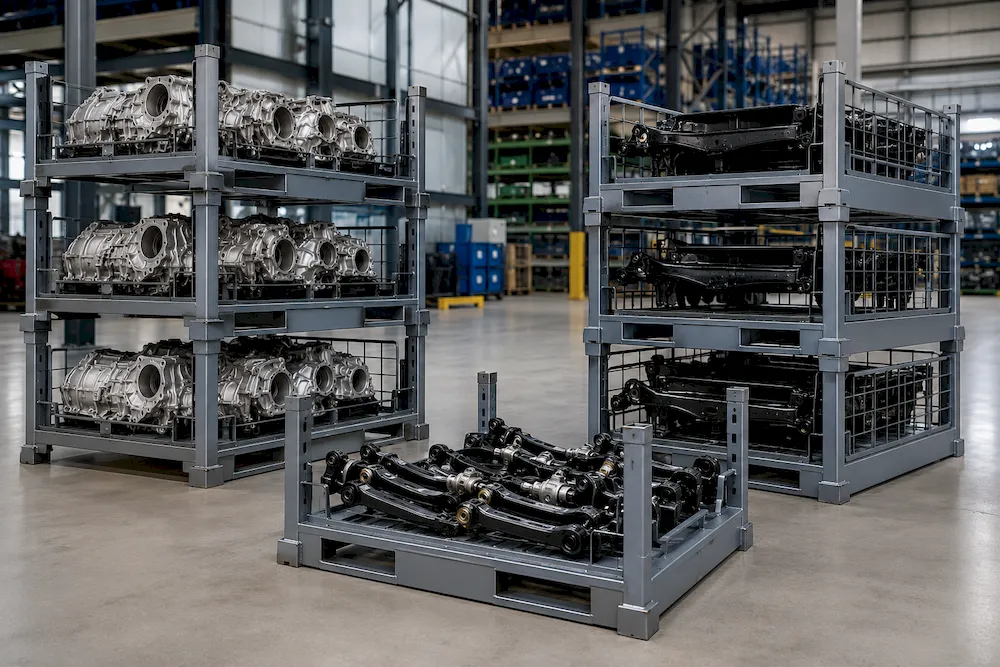
Catalytic Converter Rack — Hydraulic Supports, Robotic Arms & EVA Inserts
A customized automotive parts rack for catalytic converter assemblies — 3-layer structure with hydraulic supports, robotic arms and EVA protective inserts for safer, easier handling.
This customized rack for catalytic converter assemblies uses a 3-layer structure with hydraulic supports, robotic arms and EVA protective inserts to prevent damage and make loading easier. Caster wheels and a stackable design improve line efficiency and save warehouse space.
Welcome to HAOFU Metal Logistics Equipment Factory. This customized automotive parts rack was designed for a catalytic converter assembly, providing safer storage and efficient handling for automotive manufacturers. With a 3-layer structure, hydraulic supports, robotic arms and EVA protective inserts, the rack helps prevent damage while making loading and unloading easier. Caster wheels and a stackable design improve production line efficiency and save valuable warehouse space.
Why catalytic converters are difficult to handle
A catalytic converter assembly is heavy, awkwardly shaped, and contains a fragile ceramic substrate inside a thin steel shell. Impact damage is often invisible from the outside but ruins the part. It also carries precious-metal coatings, so scrap is expensive. Handling has to be gentle, repeatable and quick.
What each mechanism does
| Mechanism | Purpose |
|---|---|
| 3-layer structure | Density without stacking assemblies on one another |
| Hydraulic supports | Take the weight of the layer so operators do not lift it |
| Robotic arms | Swing the part out to a comfortable working position |
| EVA protective inserts | Cradle the shell and absorb impact that would crack the substrate |
| Caster wheels | Move the rack to the station without a forklift |
| Stackable frame | Saves warehouse space and cuts empty return volume |
Ergonomics is part of the protection
Hydraulic supports and swing-out arms are not luxuries — they exist so an operator never has to lift or twist awkwardly, which is where most drops and knocks happen. Designing to recognised manual-handling limits, such as those in OSHA materials-handling guidance, protects the part and the person at the same time. See how the same thinking applies to line feed in our guide to line-side and sequencing racks.
Need a customized rack for your assembly?
Read how we engineer racks around a single part in our automotive parts rack design guide, browse automotive parts racks and material handling trolleys, or send us your part drawings — we provide professional design and solutions within 24 hours.
Frequently Asked Questions
- Why do catalytic converters need a specialised rack?
- The assembly is heavy and awkward, and holds a fragile ceramic substrate inside a thin steel shell. Impact damage is often invisible from the outside but ruins the part, and the precious-metal coating makes scrap expensive — so handling must be gentle, repeatable and quick.
- What do the hydraulic supports do?
- They carry the weight of each layer as it opens, so the operator does not lift it. That removes the awkward lifting and twisting where most drops and knocks happen, and makes the loading cycle repeatable rather than dependent on the operator.
- What are the robotic arms on this rack?
- They are mechanical swing-out arms that bring each part to a comfortable working position instead of making the operator reach into the rack. Combined with the hydraulic supports they cut both cycle time and handling damage.
- How do EVA inserts protect the converter?
- Each insert is shaped to cradle the converter's shell, spreading contact over a wide area and absorbing the impact and vibration that would otherwise crack the ceramic substrate inside. The inserts are replaceable wear items.
- Can the rack be stacked and moved without a forklift?
- Yes. Caster wheels let staff roll the rack to the station manually, and the stackable frame means loaded or empty racks interlock vertically to save warehouse space and reduce return freight.