
Application
EV Battery Racks
EV battery racks are custom returnable carriers for a defined battery pack, tray, substrate or related component. The rack layout follows the component geometry, permitted contact areas, lifting or assembly access, cleanliness needs, handling equipment and return route.
Reviewed by Ms. Zhao · Last reviewed 2026-09-02
Direct answer
An EV battery rack is engineered from the approved component geometry, mass and centre of gravity, permitted contact zones, loading method, equipment interfaces, route and stacking state. Electrical, ESD, dangerous-goods or regulatory requirements are project-specific and must be supplied or confirmed by the buyer and relevant qualified parties; they are not implied by the steel frame alone.
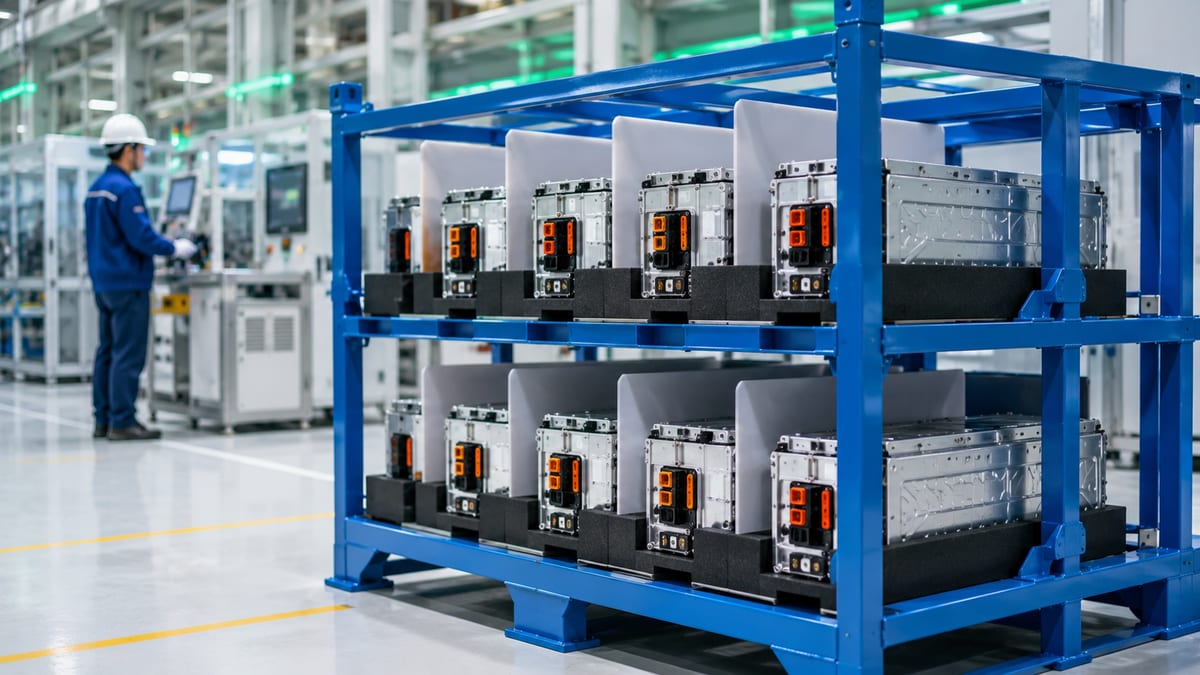
Component and interface first
The project begins by defining whether the carrier holds a pack, tray, substrate or another component and which surfaces may be contacted.
- Controlled part revision and envelope
- Permitted supports and restricted zones
- Loading access and fixture movement
- AGV, fork, conveyor, crane or line-side interfaces
- Identification and traceability fields required by the programme
Project-specific risk controls
Any ESD, electrical isolation, dangerous-goods, cleanliness, fire, transport or plant rule must be identified in the buyer's specification and reviewed by the responsible qualified parties. HAOFU does not infer these requirements from the application name.
EV battery-rack RFQ decisions
Use this matrix to identify required project inputs. It does not publish universal dimensions, load ratings or tolerances.
| Decision | Guidance | Buyer input |
|---|---|---|
| Component scope | Identify the exact pack, tray, substrate or part revision. | Drawing/CAD, mass, centre of gravity |
| Contact strategy | Define allowed supports and surfaces that must remain clear. | Contact map and protection requirements |
| Automation interface | Match the actual AGV, conveyor, shuttle, fork or robot datum. | Equipment interface drawing/manual |
| Plant and route requirements | List transport, ESD, identification, cleanliness and site-specific needs explicitly. | Buyer specification and responsible approval party |
Project workflow
- 1
Freeze the part input
Identify the controlled component revision and provide its geometry and mass properties.
- 2
Define contact and access
Mark permitted support zones, restricted surfaces and the loading sequence.
- 3
Confirm every interface
Provide handling-equipment and route interfaces, including loaded and empty-return states.
- 4
Agree validation
Create a project-specific sample, inspection and validation plan before production approval.
Review an EV battery-rack requirement
Provide the controlled part information, contact map, handling interfaces and programme requirements so the project can be scoped without guessed parameters.
Send drawings or requirements