
The Rack Specification Sheet: 20 Data Points Your Manufacturer Needs
A rack specification sheet turns a vague quote request into an engineering brief. Send the part data, loaded weight, contact points, handling interface, space limits, return-loop conditions and approval criteria; those inputs let a manufacturer design, price and validate the same rack you intend to use.
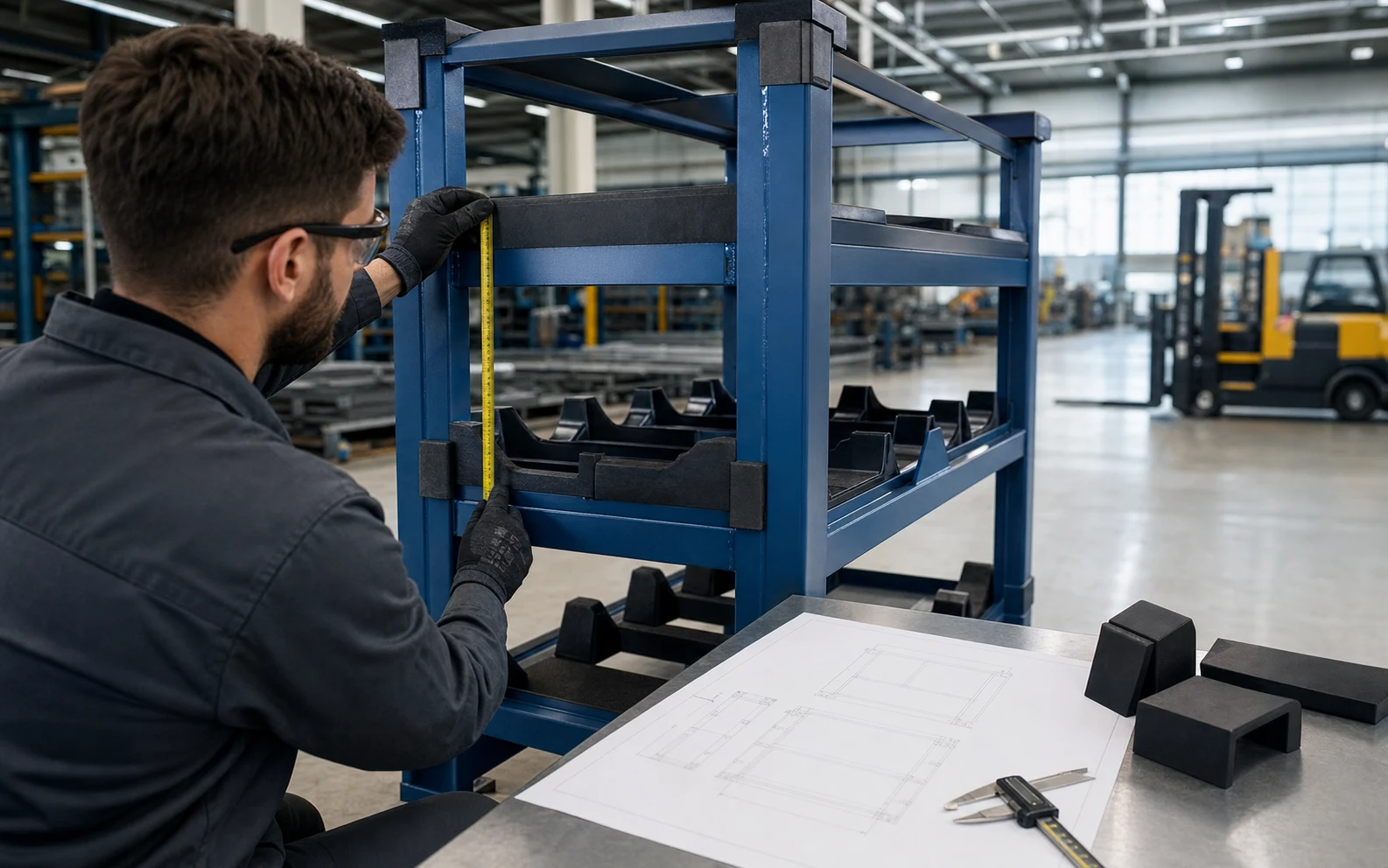
A rack specification sheet is the engineering brief that tells a manufacturer what a custom steel rack must hold, protect, survive and fit through. It is not a catalogue form. A usable RFQ gives enough facts to design around the part and the real material flow—not enough vague language to produce incomparable quotes.
This guide is for purchasing managers, logistics engineers and project engineers. Use it before asking for price so that drawing review, quotation, sample approval and final inspection all use the same reference.
Quick answer: what belongs in a rack specification sheet?
Start with the part and the process. Record the part drawing or sample, dimensions, mass, orientation and protected contact points; then add quantity per rack, handling equipment, stacking or return-loop needs, space limits, finish environment and approval evidence. The finished sheet becomes the shared reference for design, quotation and release.
The 20 data points to put in your RFQ
| # | Data point | What to provide |
|---|---|---|
| 1 | Part identity | Part number, revision, drawing or photos. |
| 2 | Geometry | Overall dimensions and irregular features. |
| 3 | Unit weight | Actual part mass. |
| 4 | Centre of gravity | Known off-centre mass or unknown. |
| 5 | Protection zones | Cosmetic, machined or no-contact areas. |
| 6 | Orientation | Loaded, stored and unloaded position. |
| 7 | Quantity | Pieces per layer and per rack. |
| 8 | Loaded mass | Part total plus travelling fixtures. |
| 9 | Load distribution | Equal, concentrated or asymmetric positions. |
| 10 | Stacking | Loaded/empty requirement and context. |
| 11 | Handling | Forklift, cart, tugger, crane, conveyor or AGV. |
| 12 | Interface | Fork entry, wheels, tow point or datum. |
| 13 | Loading access | Operator reach, robot path, doors or bars. |
| 14 | Facility limits | Aisles, doors, lifts and line-side footprint. |
| 15 | Transport | Truck, container, crate and restraint needs. |
| 16 | Return loop | Empty return, dwell time, pooling or ownership. |
| 17 | Environment | Indoor, humid, wash-down, oil or outdoor use. |
| 18 | Identification | Label, barcode or RFID-ready location. |
| 19 | Quantity forecast | Sample, first order, annual volume and date. |
| 20 | Approval evidence | Drawing sign-off, loading trial, inspection and packing records. |
How to turn the checklist into an engineerable brief
- Freeze the part revision. Attach the current drawing, photos or a sample; name variants explicitly.
- Map the physical journey. The MHI guide identifies access, environmental exposure, stackability and handling as selection inputs.
- Separate facts from preferences. Door height is a constraint; colour is a preference.
- Compare like for like. Ask suppliers to show their assumptions for dunnage, stacking, finish and packing.
- Define the sample test. State who loads it, which route it travels and what proves acceptance. RMI advises comparing rack condition with the manufacturer’s approved configuration information, not appearance alone.
Common RFQ mistakes
- Sending overall dimensions without fragile faces or contact points.
- Using “load capacity” without saying whether storage, handling, stacking and transport apply.
- Leaving fork entry, towing or automation interfaces implied.
- Approving a drawing but not a loaded sample trial.
Copy/paste RFQ starter
Send: part number/revision; drawing/photos; dimensions and weight; parts per rack; protected areas; orientation; loaded mass; stacking; handling equipment/interface; access; facility/transport limits; environment; identification; quantity/date; and required approval evidence.
Turn your inputs into a custom rack brief
Use our customization page to send the drawing, route and expected quantity. Read the factory-direct buyer’s guide and the automotive rack design guide before releasing an RFQ. When the sample is ready, use the related pre-shipment inspection checklist.