
Metal Containers or Plastic Bins? Choosing for Industrial Parts
Metal container vs plastic bin is a process decision, not a universal material ranking. A steel container may suit a rigid, welded, part-specific enclosure or a demanding handling route; a plastic bin may suit lower tare weight, manual handling, cleanability or a standard tote workflow. Compare the part, access, environment, handling equipment, return loop and validation evidence before choosing.
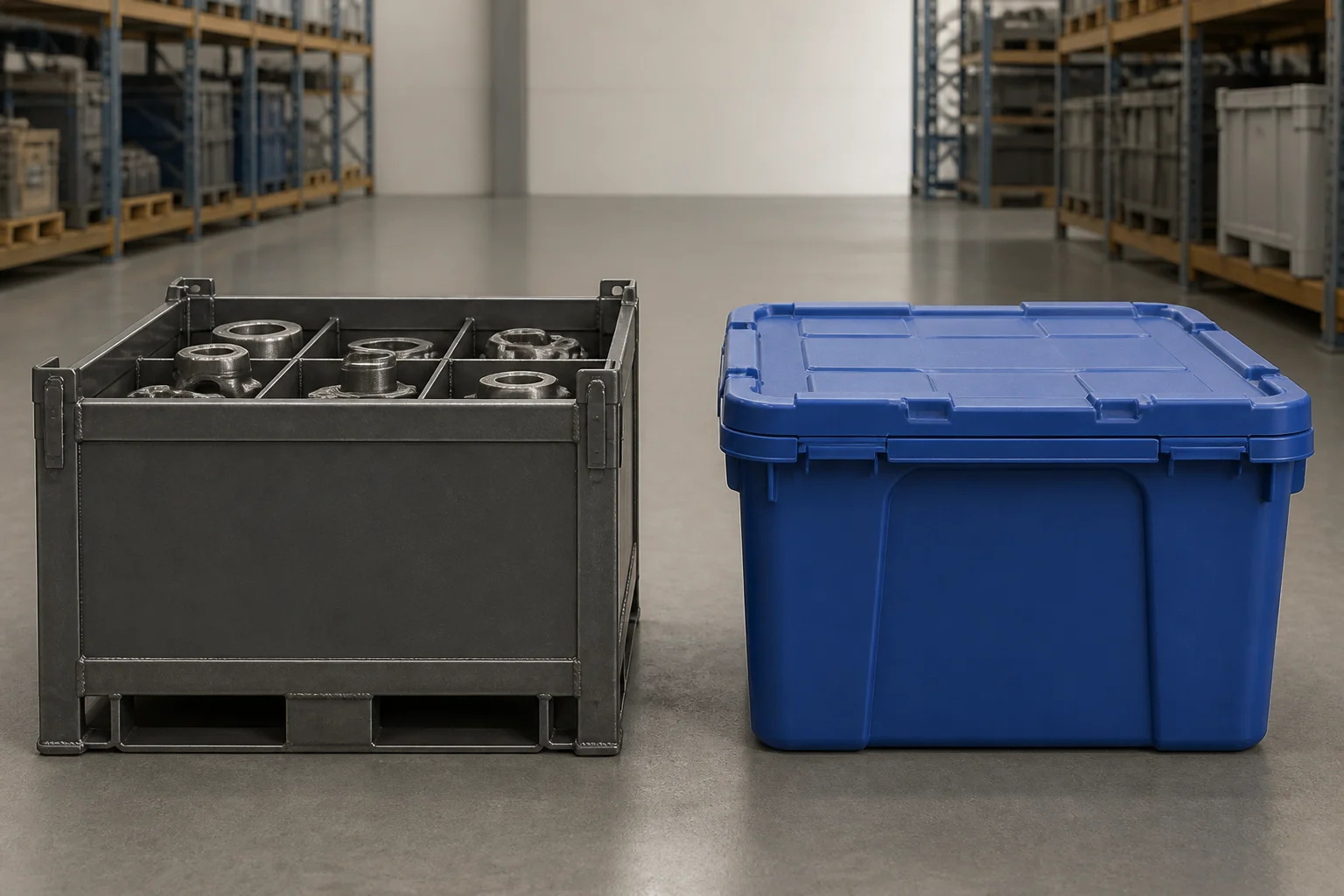
Metal container vs plastic bin is best answered by the part and process, not by saying one material is always stronger, lighter or cheaper. A custom steel container can provide a rigid, welded structure with project-specific dividers, doors, lids and handling interfaces. A plastic bin can be a practical choice when lower tare weight, manual handling, cleaning or a standard tote workflow matters. Both need an application review.
This guide is for procurement managers, manufacturing engineers and warehouse or logistics leaders choosing a returnable container for industrial parts. It deliberately avoids universal payloads, dimensions, stack heights, prices, certifications and unverified material-performance promises.
Quick answer: when should you choose metal or plastic?
Choose a metal container when the project needs a rigid, part-specific frame, welded interfaces, custom access or a defined industrial handling route that should be validated around the actual part. Choose a plastic bin when a lighter hand-held format, a standard tote ecosystem, cleanability or a nestable/stackable polymer format better fits the workflow. If the part is sensitive, dense, oily, hot, sharp-edged or automated, validate the complete loaded cycle before release.
MHI's packaging reference lists metal, welded wire mesh, corrugated plastic and HDPE among common packaging materials and distinguishes bins, totes, bulk containers and pallets by function. The RPA's reusable packaging definition reinforces that the container is part of a repeated supply-chain system, not just a one-time box purchase.
Metal container vs plastic bin at a glance
| Decision factor | Custom metal container | Plastic bin or tote | Question for the buyer |
|---|---|---|---|
| Part protection | Rigid frame, panels and custom dunnage can be arranged around defined contact points. | Polymer walls and inserts can support a lighter, standardised handling pattern. | Which surfaces may touch the container, and what movement must be prevented? |
| Handling | Fork pockets, pallet-truck access, casters, tow points or lifting interfaces can be designed into the structure. | Handles and standard footprints may suit manual or established tote flows. | What equipment moves the loaded unit at each hand-off? |
| Access | Doors, drop panels, removable posts, lids and dividers can be engineered to the work sequence. | Open bins, attached lids and standard access formats may reduce complexity. | Is the unit opened every cycle, only at receipt, or never during transport? |
| Environment | Finish, drainage and contact protection must match humidity, wash-down, oil and outdoor exposure. | Polymer compatibility with temperature, impact, cleaning chemistry and part edges must be checked. | What is the actual exposure, and what evidence is required? |
| Empty return | May use nesting, folding or removable panels when the geometry permits. | May use stack, nest or collapsible formats available in the selected system. | How are empty units collected, separated, stored and redeployed? |
| Change control | Welded and part-specific features may require drawing revision and sample review for changes. | Standard bins may be quicker to substitute, while custom inserts still need review. | How often will the part, quantity or handling route change? |
Where a steel bin or metal container can be a fit
A steel bin versus plastic tote decision often favours metal when the buyer needs a welded structure with a project-specific base, divider system, lid, door, fork entry or tow interface. The container can be designed around an irregular part, a repeatable presentation position or a route where the frame itself is part of the handling system.
That does not mean every steel container is appropriate for every load. Review the actual part weight, concentrated contact, handling shock, surface sensitivity, corrosion exposure and intended stacking or transport state with the supplier. HAOFU's custom metal containers are developed from the part and factory requirements; the product page is a starting point for a project brief, not a universal catalogue rating.
Where a plastic bin or tote can be a fit
Plastic bins and totes can fit workflows that prioritise lower tare weight, manual handling, standard footprints, cleanability or established reusable-tote equipment. ORBIS's hand-held container guide describes plastic totes as reusable containers used to hold and move parts in manufacturing and highlights the importance of configuration, size and application when selecting them.
Plastic is not a shortcut around engineering. Check temperature, chemical exposure, impact, sharp edges, cleaning method, lid access, deformation during storage and compatibility with conveyors or automation. A standard tote can be a good fit for one part family and a poor fit for another.
Do not confuse a container, bin, pallet and stillage
Terminology changes the buying brief. A bin or tote generally organises smaller parts for a work cell or repeated handling; a bulk container encloses a larger unit load; a steel pallet is primarily a flat base; and a stillage adds a frame, posts or containment without necessarily becoming a closed box. The distinction matters because each form solves a different access and handling problem.
For a deeper definition, read what a custom metal turnover box is. For a structural comparison, see mesh container versus solid steel container and stillage versus pallet versus wire container.
Five-step material choice process
- Define the part. Freeze dimensions, weight, contact points, surface restrictions, orientation and quantity per unit.
- Map the route. Record loading, unloading, storage, transport, cleaning, inspection and empty return.
- Compare interfaces. Check dividers, lids, access doors, fork entry, casters, labels and automation interfaces for each candidate.
- Review the environment. Confirm temperature, moisture, oil, cleaning chemistry, impact and sharp-edge exposure with the relevant technical owner.
- Validate the loaded unit. Use the real part and intended equipment, then record approved changes before production or fleet release.
Common mistakes in a returnable container material choice
- Choosing steel or plastic from a generic durability claim without defining the route and part contact.
- Comparing a steel container with a hand-held plastic tote as if they serve the same handling class.
- Ignoring tare weight and operator reach because only the loaded unit was considered.
- Checking loaded storage but not empty nesting, return freight, lid storage or divider control.
- Assuming a standard footprint, capacity or stack condition transfers across materials without validation.
- Adding certification or food-grade language without identifying the destination requirement and evidence owner.
Make the comparison quote-ready
Send the supplier the part drawing or photos, quantity per unit, protection zones, handling equipment, route, environmental exposure, empty-return requirement and target documentation. A good quotation should state its assumptions for the container body, dunnage, access, finish, identification and sample approval.
Use the custom metal containers page when a steel solution may fit, and compare this article with custom metal container design for dividers, lids and nesting. For related returnable-program controls, read who owns the racks and how deposits are discussed.
Next step: ask for a side-by-side matrix that names the part assumptions, handling interfaces, loaded and empty conditions, validation method and change-control owner. That gives procurement and engineering a shared basis for the material decision.