What Is a Metal Turnover Box? Types, Sizes and Uses

A custom metal turnover box is a reusable steel container engineered around a part, its protection points and the way it is loaded, moved, stored and returned. It can use solid or mesh panels and options such as lids, doors, dividers, forklift pockets or casters. It is not a universal size or load rating, and it is different from a wire mesh container, a flat steel pallet and a plastic tote.
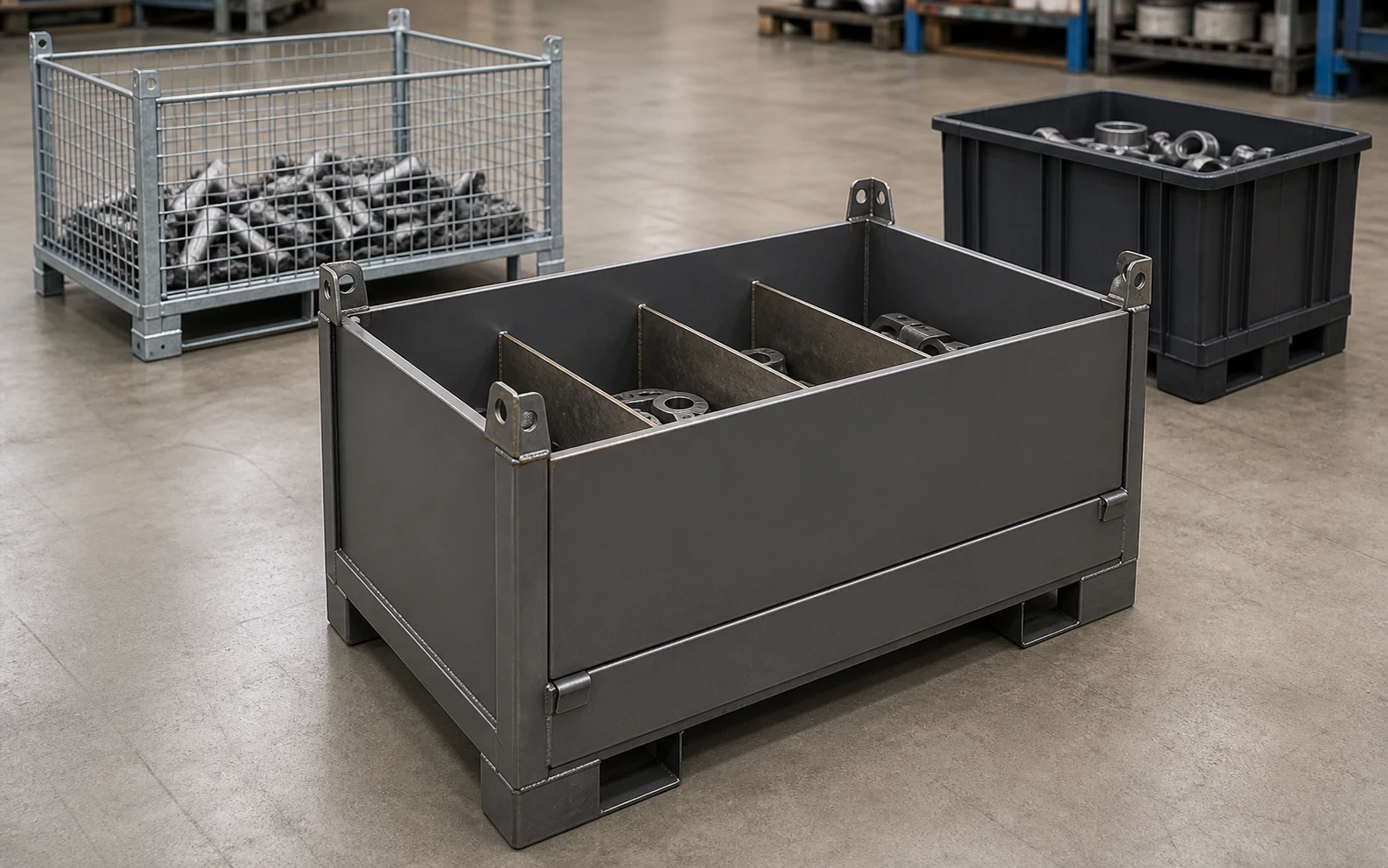
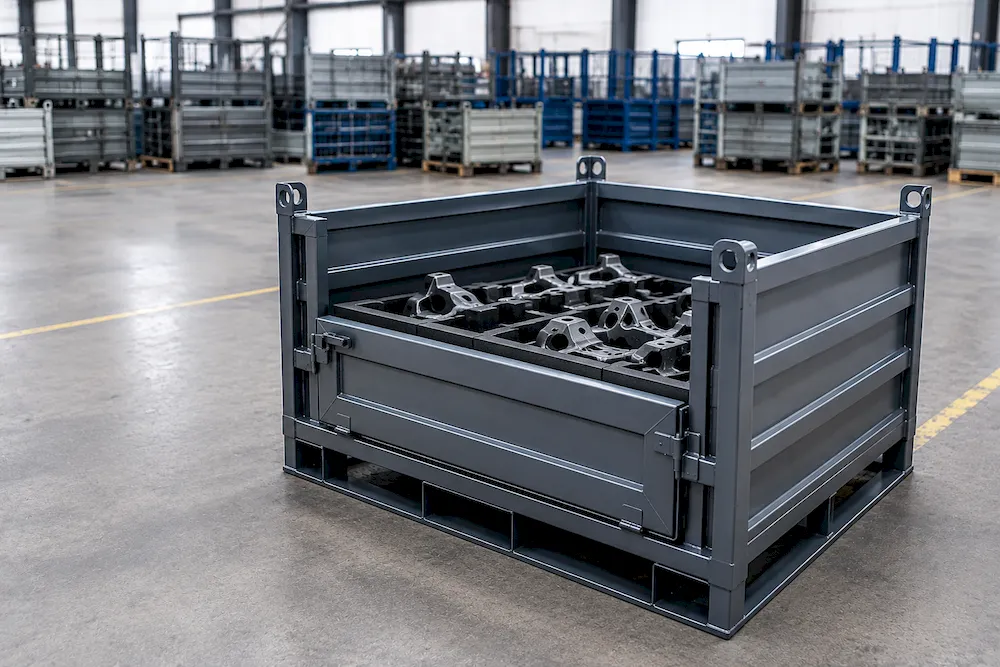
A custom metal turnover box is a reusable steel container designed to store, handle and transport parts or production materials through a repeated industrial flow. Unlike a generic bin, it is engineered around the part envelope, contact points, access method, handling equipment, storage limits and empty-return needs. The construction may use a welded steel frame with solid or mesh panels, plus project-specific features such as lids, doors, drop-down panels, dividers or forklift interfaces.
“Turnover” describes repeated use and movement; it does not define one universal dimension, payload or certification. A box that works for one part and route may be wrong for another. Manufacturing engineers, warehouse buyers and automotive suppliers should therefore choose the container and its data sheet together.
Quick answer: what is a metal turnover box used for?
It is used when a reusable, rigid container needs to protect and organise parts during storage, line-side supply, internal movement, shipping or a returnable logistics loop. The design decision starts with the part and process: what must be enclosed, what must remain visible, how the operator accesses it, how it is moved, how it stacks or folds when empty, and what environmental exposure it sees.
The HAOFU custom metal container page describes welded steel frames with steel or mesh panels and project options including internal dividers, protection, handling interfaces, stackable structures and foldable or removable panels. These are configurable choices, not a promise that every option belongs in every box.
Metal turnover box types compared
| Type | Containment | Typical reason to consider it | Questions to confirm |
|---|---|---|---|
| Solid-panel steel turnover box | Welded steel frame with solid sides or panels; can include internal protection. | Parts need enclosure, controlled contact points or protection from surrounding handling. | Where are the loading openings, dividers, drains, inspection points and access interfaces? |
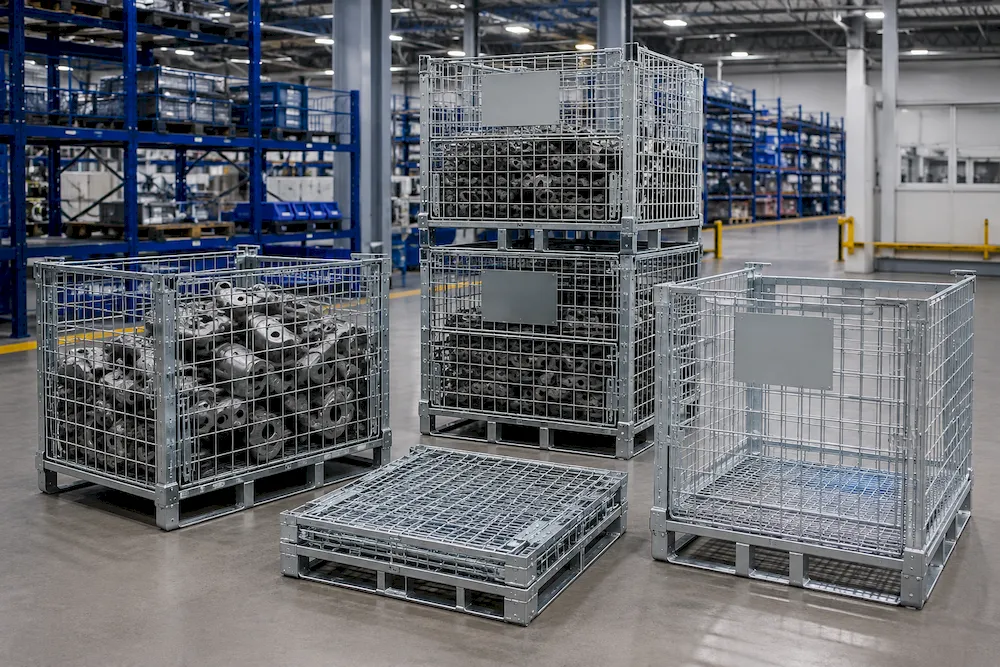
| Wire mesh container | Open metal mesh around a base and frame; contents remain more visible and ventilated. | Operators need visual identification or airflow and the parts do not require solid-wall containment. | Could a mesh opening allow a part to protrude, snag or contact another part? |
| Steel pallet or stillage | A pallet is primarily a load-bearing base; a stillage adds a frame, posts or containment. | A unit load needs forklift handling, stacking or a defined support frame rather than a closed box. | Does the part need side protection, dividers or a box-like enclosure, or only a stable base? |
| Plastic tote or bin | Molded or formed polymer container, often selected in nestable, stackable or open-bin formats. | Lower tare weight, cleanability, manual handling or a standard small-parts workflow is important. | Will temperature, impact, part edges, cleaning chemistry or repeated return handling change the choice? |
Common configurations inside a custom steel turnover container
A turnover box becomes useful when its structure matches the work sequence. Possible design questions include:
- Panels and openings: solid sides for containment, mesh for visibility, or a combination where operators need both.
- Loading access: a lid, door, drop-down panel or open face can change reach, cycle time and part protection.
- Part separation: removable dividers, shelves, rubber pads, foam, plastic blocks or straps can keep defined contact points from shifting.
- Handling interface: forklift pockets, pallet-truck access, casters, brakes, lifting points or tow bars must match the equipment and route.
- Storage and return: stackable geometry, removable panels or foldable structures may reduce floor use or empty-return volume, but the loaded and empty states both need review.
- Finish and identification: choose the surface treatment for the environment and reserve a clear location for the asset label or part information.
Do not treat a feature list as a specification. For example, a lid may protect a part but also restrict inspection or add a handling step; a divider may improve separation but reduce the quantity per box. Test the complete working sequence with the real part.
How to choose size without guessing
There is no universal “metal turnover box size” that fits every automotive or industrial part. Start with the part's overall envelope, protrusions, protected surfaces, orientation and required clearance. Then add the internal support or dunnage, the access path, the frame thickness, the handling interface and any stack or return constraint. The result is a design envelope, not a keyword-driven standard.
For a credible quote, send the part drawing or clear photos, dimensions and weight, quantity per container, contact points, protection needs, handling equipment, floor and doorway limits, stacking or folding requirement, surface environment, required quantity and target date. HAOFU's custom metal container information lists these inputs because a container is developed around the product and factory conditions rather than selected from one fixed rating.
Common mistakes when buying a steel turnover container
- Searching for a nominal size before measuring the part and its protection zones.
- Calling a pallet, stillage, mesh cage and closed turnover box the same product.
- Specifying only gross dimensions and forgetting forklift entry, door swing, divider removal or operator reach.
- Choosing a load figure without defining whether it covers the actual base, stacking condition, handling method or transport route.
- Approving an empty box without loading a real part and checking the return or line-side process.
- Adding “certified” or “food grade” language without identifying the applicable standard, test or authority for the destination.
Five-step selection process
- Define the part. Freeze the drawing revision, dimensions, weight, contact points and cosmetic restrictions.
- Define the work sequence. Document loading, unloading, storage, transport, cleaning and empty return.
- Choose the containment level. Decide between solid panels, mesh, a pallet/stillage structure or plastic based on protection, visibility and process needs.
- Specify interfaces and evidence. Add handling openings, access features, identification, finish and the inspection or sample-approval method.
- Validate the loaded sample. Use the real part and intended equipment, then record drawing changes before production.
For broader material-handling context, the MHI packaging overview separates reusable containers, bulk containers and pallets by their functions and notes that stackability varies with construction. GlobalSpec's totes and bins guide likewise describes material, access, size and handling features as selection inputs. The Suppliers Partnership packaging guidance adds a useful lifecycle reminder: evaluate returnable packaging against the full product and logistics cycle rather than a single trip.
Choose the container around the real process
When the part, route and handling equipment are known, a custom metal turnover box can be developed as a documented engineering solution rather than a generic “heavy-duty” box. Use the custom metal containers page to send your drawings and requirements. For the adjacent rack and container commercial model, read who owns returnable racks and how deposits are discussed; for a direct type comparison, see stillage vs pallet vs wire container and collapsible wire mesh containers.
Next step: send the part drawing or sample information, required quantity, handling method and return-loop constraints so the engineering team can review a container concept with explicit assumptions.
Frequently Asked Questions
- What is a custom metal turnover box?
- It is a reusable steel container engineered around a part and its handling route. It may use solid or mesh panels and options such as dividers, doors, lids, forklift pockets or casters, but its dimensions and load conditions are project-specific rather than universal.
- How is a steel turnover container different from a wire mesh container?
- A steel turnover box can use solid panels for enclosure and controlled protection, while a wire mesh container prioritises visibility and airflow through its open sides. The correct choice depends on the part, access, protection and environment; neither label alone defines a standard performance level.
- Is a metal turnover box the same as a steel pallet?
- No. A steel pallet is primarily a flat base for assembling and moving a unit load. A turnover box encloses or organises parts with walls, panels or internal supports; a stillage sits between those ideas when it uses a frame or posts without becoming a closed box.
- Are metal turnover boxes available in standard sizes?
- Some suppliers may offer catalogue formats, but a custom metal turnover box should be sized from the part envelope, clearances, dunnage, handling equipment, facility limits and return requirements. Do not assume a nominal size or load rating is suitable without a drawing and loaded validation.
- What information should I send a metal container manufacturer?
- Send the part drawing or photos, dimensions and weight, quantity per container, protected contact points, loading orientation, handling method, stacking or folding needs, environment, finish, required quantity and target date. Include the sample-approval or inspection evidence you expect.