Returnable Racks for EV Battery Packs & Modules: Safety, Sizing & Handling

Returnable racks for EV battery packs must handle heavy modules, insulate terminals to prevent short circuits, absorb impact and support fire-safe storage. They fixture each pack precisely and, because batteries are dangerous goods, form part of a compliant transport system.
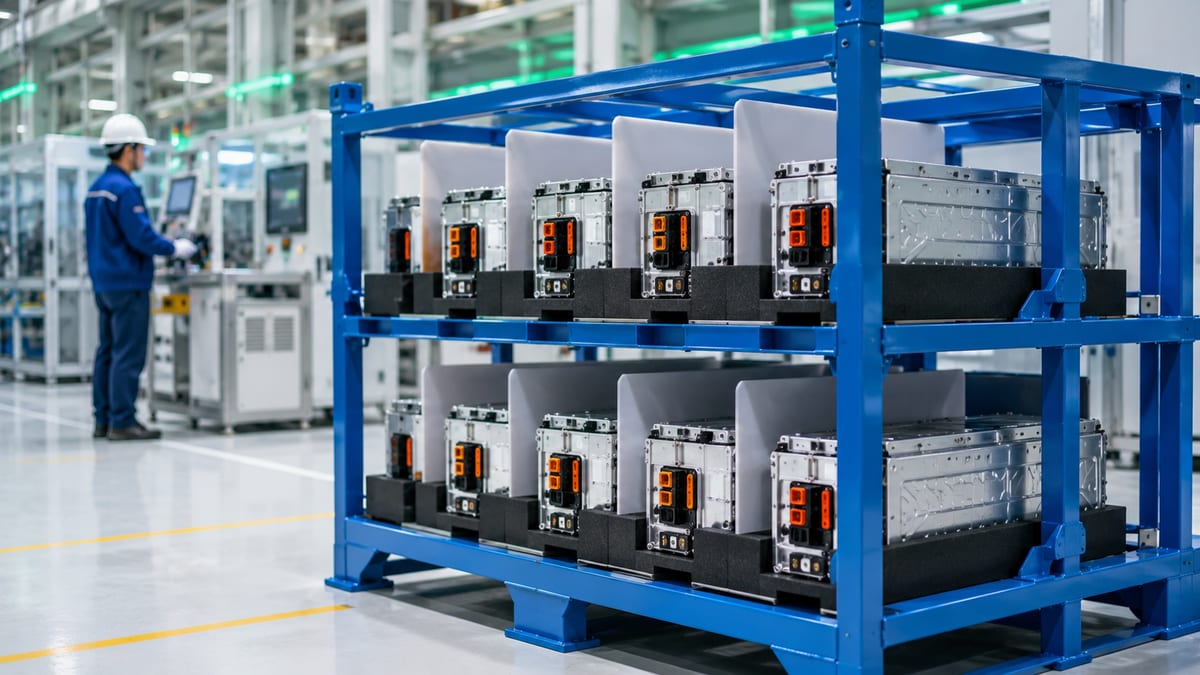
Returnable racks for EV battery packs and modules must do more than hold weight — they have to protect a heavy, sensitive and potentially hazardous product through repeated handling. Lithium-ion batteries demand attention to load capacity, electrical insulation, short-circuit prevention, impact protection and, ultimately, fire safety.
Quick answer: EV battery pack racks
An EV battery rack must carry heavy, dense modules on heavier-gauge steel, insulate contacts so terminals cannot short, cushion against impact and vibration, and hold each pack in module-specific pockets. Because lithium-ion batteries are dangerous goods in transport, the rack is only one part of a compliant, fire-aware system — confirm requirements with your safety teams.
Why EV batteries need purpose-built racks
Battery packs are dense and heavy, terminals must never short, and any impact or deformation is a safety risk. A generic stillage is not enough. The rack must fixture each module precisely, insulate contacts and absorb handling shocks.
Hazards and the design response
| Hazard | Design response |
|---|---|
| High mass | Heavier gauge steel, verified single & stacked load rating |
| Terminal short-circuit | Insulating liners, non-conductive dividers, no exposed metal at contacts |
| Impact / vibration | Foam cradles, precise fixturing, shock-absorbing bases |
| Thermal / fire risk | Spacing, ventilation and compatibility with fire-safe storage practice |
| Precise orientation | Module-specific pockets so packs cannot shift |
Safety and compliance
Lithium batteries are classed as dangerous goods in transport, governed by the UN Model Regulations and regional rules such as UNECE dangerous goods frameworks. Storage and fire precautions should align with recognised standards from bodies like the NFPA. The rack is one part of a compliant system — always confirm requirements with your logistics and safety teams.
Sizing and handling
Size the rack to the module and to your transport: check forklift access, stack limits and container fit. Foldable or stackable designs cut return freight. Pair the racks with material handling trolleys for safe line-side movement, or build on a steel pallet base for automated handling.
Get an EV battery rack specified
As a custom manufacturer serving EV supply chains, HAOFU designs battery racks around your module data and safety requirements. Share your specifications and our engineers will propose a compliant, tested design.
See how we build custom racks in our automotive parts racks manufacturer video.
Frequently Asked Questions
- Why do EV battery packs need special racks?
- Battery packs are heavy, sensitive to impact, and their terminals must never short-circuit. A generic stillage cannot fixture them precisely or insulate contacts, so purpose-built racks with module-specific pockets, insulation and shock protection are required for safe handling.
- How do you prevent short circuits in a battery rack?
- Use non-conductive liners and dividers, keep exposed metal away from terminals, and fixture each module so it cannot move and bridge contacts. The rack is designed so batteries stay isolated and located throughout handling.
- Are EV battery racks regulated for transport?
- Lithium batteries are dangerous goods in transport, governed by the UN Model Regulations and regional rules (e.g. ADR/UNECE), with storage and fire precautions guided by bodies such as the NFPA. The rack is one part of a compliant system — confirm requirements with your logistics and safety teams.
- Can EV battery racks be returnable and foldable?
- Yes. Battery racks can be designed as stackable and/or foldable so they cycle efficiently through a closed-loop returnable program while still meeting load, insulation and protection requirements.
- How are EV battery packs protected from impact and vibration in the rack?
- Impact and vibration are handled with foam cradles, precise fixturing and shock-absorbing bases, so each module is cushioned and cannot shift during handling. Because battery packs are heavy and sensitive to deformation, the rack fixtures every pack in a module-specific pocket that stops movement, working alongside the insulation that prevents terminal short circuits.