
Application
Line-Side Material Handling
Line-side material handling racks and trolleys present defined parts at the point of use and connect storage, replenishment and empty-return flow. The right format depends on the part, sequence, operator reach, aisle, replenishment method and plant equipment—not on a single standard trolley or rack layout.
Reviewed by Ms. Zhao · Last reviewed 2026-09-02
Direct answer
Select a line-side rack or trolley by mapping the part presentation and replenishment process first. Confirm quantity per carrier, sequence/FIFO need, operator access, footprint, caster or feet arrangement, tugger/AGV/fork interface, labels and empty-return path. These inputs decide whether a static rack, mobile trolley, flow rack or mother-daughter arrangement is appropriate.
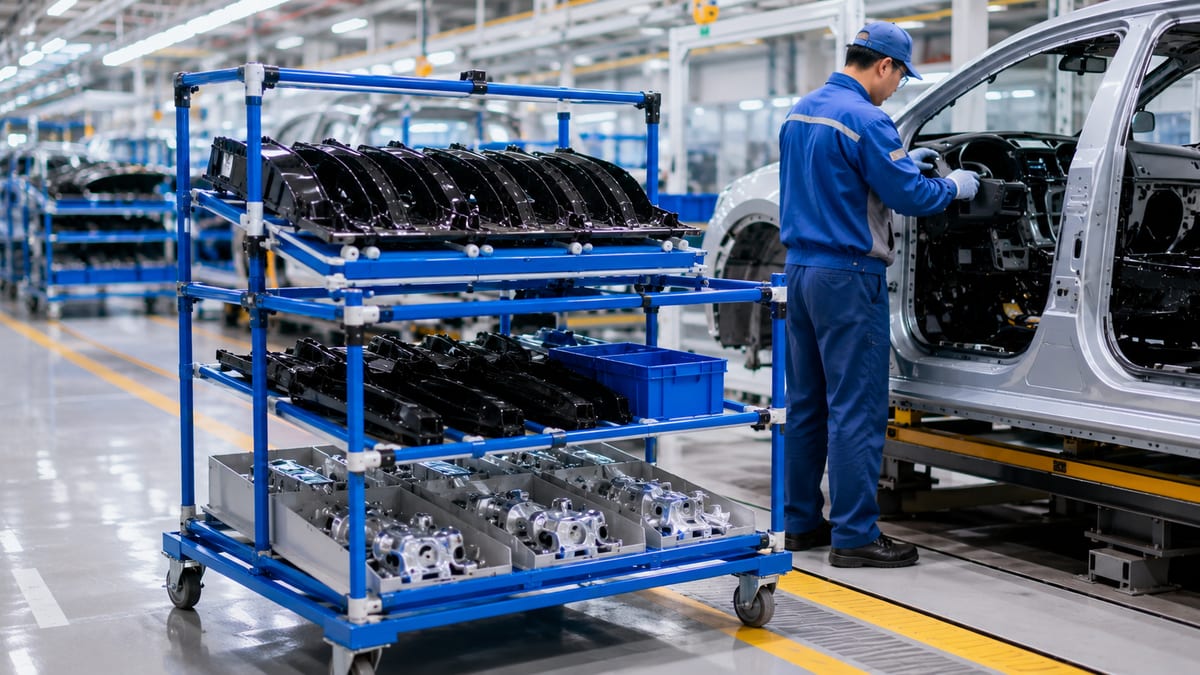
Match the carrier to the flow
A carrier should support the defined replenishment and picking method without blocking required access or equipment interfaces.
- Part orientation and pick sequence
- Quantity per carrier and replenishment trigger
- Operator reach and access direction
- Aisle and station footprint
- Tugger, AGV, fork, caster or docking interface
- Empty-return and identification process
When a trolley is not the answer
If the station requires fixed gravity flow, pallet storage or crane handling, another product family may be more appropriate. The application review should route the buyer to the correct product rather than force every requirement into a trolley.
Line-side format selection
Use this matrix to identify required project inputs. It does not publish universal dimensions, load ratings or tolerances.
| Decision | Guidance | Buyer input |
|---|---|---|
| Static presentation | Use a fixed rack where mobility is not part of replenishment. | Station footprint, access and anchoring/site rules |
| Manual mobile flow | Review caster, handle, braking, floor and operator requirements. | Route, floor, speed and handling method |
| Tugger/AGV flow | Match coupling, tracking, docking and equipment interfaces. | Vehicle/interface specification |
| FIFO presentation | Define lane, container and replenishment direction. | Container size, sequence and station layout |
Project workflow
- 1
Observe the current flow
Record how parts arrive, queue, present, empty and return.
- 2
Define the part presentation
Confirm orientation, quantity, sequence, contact and access needs.
- 3
Confirm plant interfaces
Provide aisle, station, floor, tugger/AGV/fork and docking information.
- 4
Trial the process
Review the sample with operators and equipment against an approved validation plan.
Map your line-side handling flow
Send the part, station, route and handling-equipment inputs for a rack or trolley concept review.
Send drawings or requirements