Foldable Wire Mesh Container Spec Guide: Sizes, Load Ratings & Mesh

Specify a foldable wire mesh container by four things: footprint size, matched to a standard pallet (e.g. 1200×1000 mm) so it seats on racking and cubes out containers; mesh and wire gauge for the smallest, heaviest part it must hold; load rating quoted as static, dynamic and stacking, with the stacked load usually governing; and a runner or foot base with a fold-flat mechanism that cuts empty return freight.
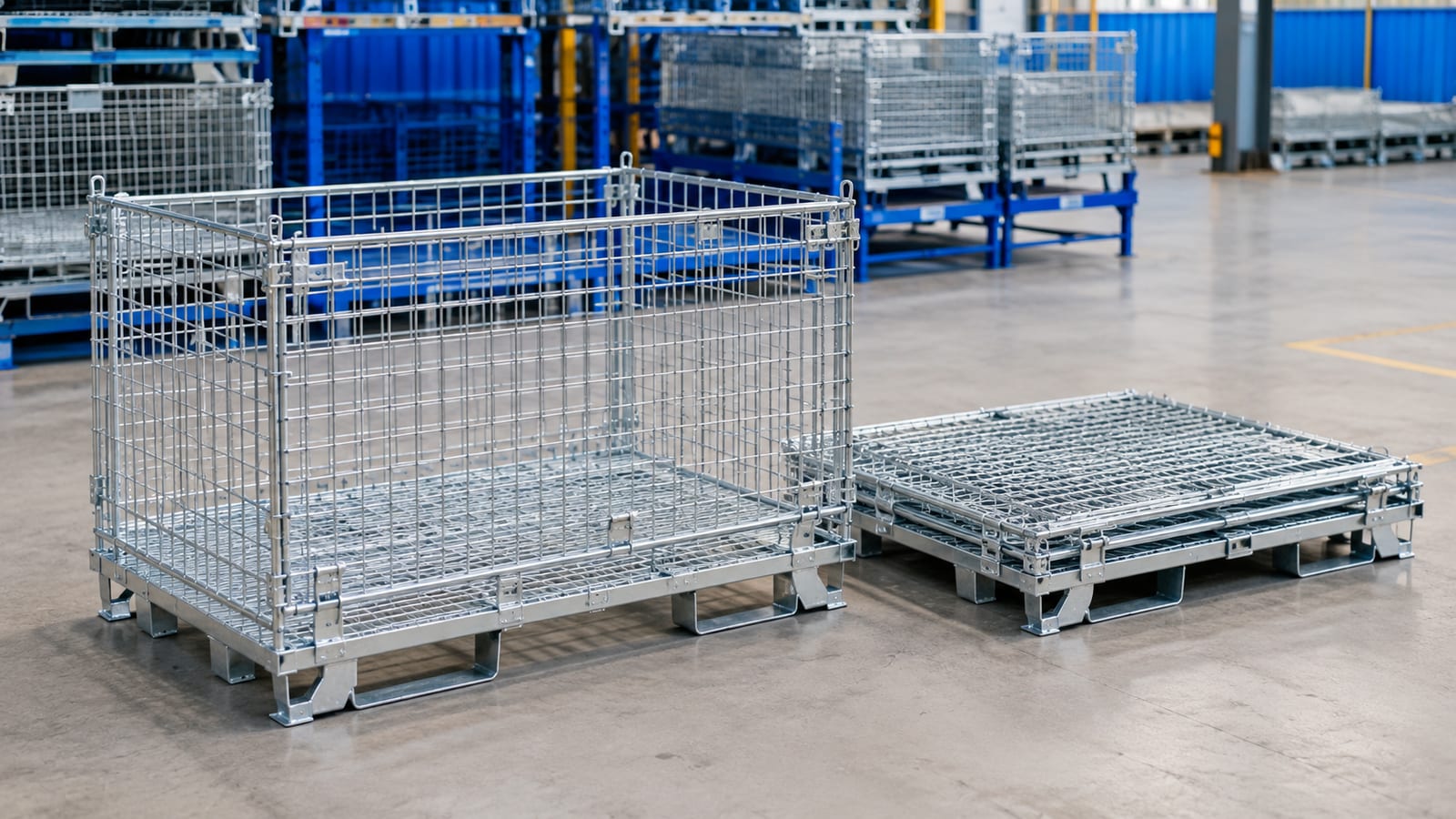
A foldable wire mesh container is specified by four things: its footprint size, the mesh and wire gauge, its load rating, and how the base and folding mechanism work. Get these right and it fits your racking, holds your parts safely and folds flat to cut return freight. Here is how to spec each.
Quick answer: speccing a foldable mesh container
Define four things: a footprint matched to a standard pallet (e.g. 1200×1000 mm) so it seats on racking and cubes out containers; mesh opening and wire gauge sized to the smallest, heaviest part; static, dynamic and stacking load ratings, with the stacked load usually governing; and a runner or foot base with a fold-flat mechanism to cut empty return freight.
The four things to specify
| Parameter | What to decide |
|---|---|
| Footprint size | Match a pallet footprint (e.g. 1200×1000 mm) so it seats on racking and cubes out containers |
| Mesh & wire gauge | Mesh opening and wire diameter set strength and what parts it can hold without falling through |
| Load rating | Static, dynamic and stacking loads — as with any steel structure, the stacked load usually governs |
| Base & folding | Runner or foot base for forklift/jack access, plus a fold-flat mechanism for empty return |
Sizing and mesh
Match the footprint to a standard pallet size so the container works with your existing racking, conveyors and containers. Choose the mesh opening and wire gauge for the smallest part it must hold and the weight it must carry — a finer mesh and heavier wire cost more but hold smaller, heavier parts. Recognised pallet and container performance methods (e.g. ISO pallet/container test standards) underpin a credible load rating.
Load ratings and folding
As with any steel structure, quote three ratings — static, dynamic and stacking — and design to the governing one; safe handling of the loaded unit should follow OSHA materials-handling practice. A robust fold-flat base is what makes the empty return leg cheap — see our guide to collapsible wire mesh containers.
Get a container specced
HAOFU builds custom foldable wire mesh containers to your parts, load and racking. Send your requirements and we will spec and load-test the right unit.
Frequently Asked Questions
- What sizes do wire mesh containers come in?
- They are usually built to standard pallet footprints (for example 1200×1000 mm) so they seat on existing racking and cube out shipping containers, but because they are custom-fabricated they can be made to any size your parts and racking require.
- What determines a wire mesh container's load capacity?
- The wire gauge, mesh opening, frame design and base all set the rating. As with any steel structure it has static, dynamic and stacking loads, and the stacking load usually governs. A credible rating is confirmed with a load test, not just a spec sheet.
- Why choose a foldable wire mesh container?
- A fold-flat base lets empty containers collapse for the return leg, cutting reverse-freight volume and storage space — important in any returnable loop. Loaded, they still stack to save floor and trailer space.
- What mesh and wire gauge should I choose?
- Choose the mesh opening for the smallest part it must hold without falling through, and the wire diameter for the weight it must carry. Finer mesh and heavier wire cost more but hold smaller, heavier parts — we match both to your part and load.
- What base and handling options do wire mesh containers have?
- The base carries the load and sets how the container is moved: a runner or foot base gives forklift or pallet-jack access, and a fold-flat mechanism lets the empty unit collapse for a cheaper return leg. The base is one of four core specifications — alongside footprint size, mesh and wire gauge, and load rating — that define a foldable mesh container.