Steel Pallet vs Plastic Pallet: Cost, Hygiene, Lifespan & Automation Fit

Choose steel pallets for heavy or concentrated loads, high temperatures and long returnable loops where they can be re-welded; choose plastic pallets for lighter loads, strict wash-down hygiene and lower weight. Compare cost per trip, not unit price.
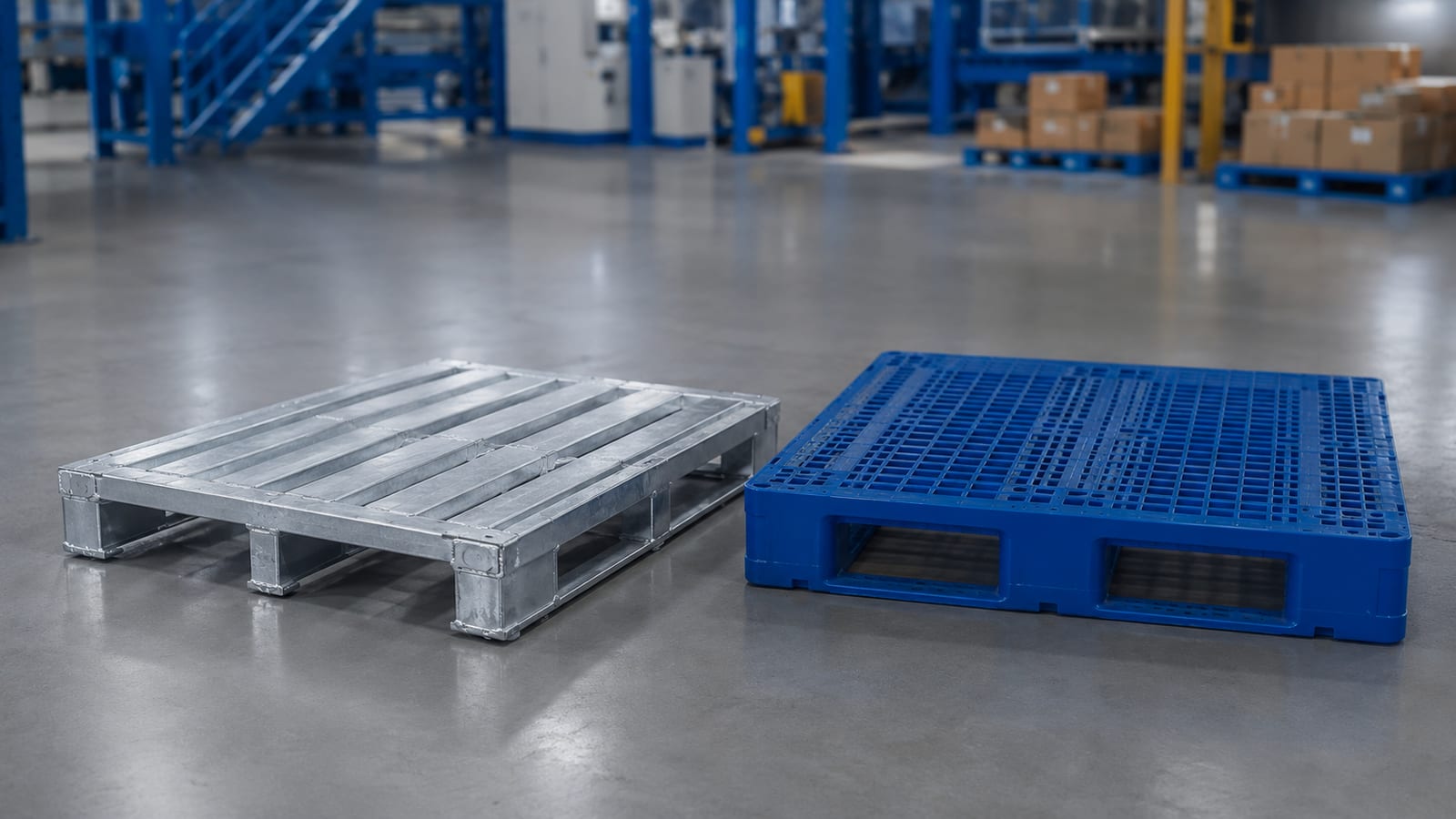
For heavy, closed-loop or automated operations, the pallet choice usually comes down to steel vs plastic — both reusable, both durable, but strong in different situations. Steel wins on heavy load and repairability; plastic wins on light weight and wash-down hygiene. Here is how to choose.
Steel vs plastic at a glance
| Factor | Steel pallet | Plastic pallet |
|---|---|---|
| Load capacity | Very high; handles heavy, concentrated loads | Moderate; best for lighter uniform loads |
| Lifespan | Very long; repairable by re-welding | Long, but cracks end its life |
| Weight (tare) | Heavier | Lighter — easier manual handling |
| Hygiene | Cleanable; galvanized resists corrosion | Excellent — washable, no absorption |
| Temperature | Wide range, incl. hot processes | Limited at high heat |
| Automation/AS-RS | Dimensionally stable and rigid | Consistent, but can flex under load |
| Cost per trip | Low for heavy, long-cycle loops | Low for light, hygienic loops |
When steel is the better choice
Choose steel for heavy or concentrated loads, high-temperature processes, long closed-loop cycles, and anywhere a damaged pallet can be re-welded rather than scrapped. Galvanized steel also suits outdoor and humid storage. Note that both steel and plastic sidestep the ISPM 15 heat-treatment rules that apply to wooden export pallets.
When plastic is the better choice
Choose plastic for lighter loads, strict wash-down hygiene (food, pharma), lower tare weight for manual handling, and highly standardised automated flows. For heavy automotive and industrial loops, steel usually wins on durability and cost-per-trip.
Also consider steel vs wood
If you are still comparing against wooden pallets, see our dedicated guide: steel pallets vs wooden pallets.
Choose the right pallet
HAOFU manufactures custom steel pallets engineered to your load, hygiene and automation needs. Tell us your operation and we will recommend the right spec.
Frequently Asked Questions
- Is a steel pallet better than a plastic pallet?
- Neither is universally better — they win in different situations. Steel is better for heavy or concentrated loads, high temperatures, long closed-loop cycles and repairability. Plastic is better for lighter loads, strict wash-down hygiene and lower tare weight.
- Are steel or plastic pallets more hygienic?
- Both are far more hygienic than wood. Plastic is excellent for wash-down as it absorbs nothing; steel is also cleanable and, when galvanized or stainless, resists corrosion in humid and wash-down environments. The best choice depends on the exact hygiene requirement.
- Which is cheaper, a steel or plastic pallet?
- Judge on cost per trip, not unit price. Steel is usually cheaper per trip for heavy, long-cycle loops because it lasts a long time and can be re-welded; plastic can be cheaper per trip for light, hygienic loops. Match the pallet to the load and cycle.
- Do steel pallets need ISPM 15 treatment for export?
- No. ISPM 15 heat-treatment or fumigation rules apply to wooden packaging. Steel (and plastic) pallets are exempt, which simplifies international shipping.