Swivel or Fixed Casters? Choose the Trolley Wheel Layout from the Route

Choose the trolley caster layout before choosing a wheel model. Four swivel casters suit short moves and sideways positioning in a tight work cell, but they can wander on a long straight run. Two fixed plus two swivel casters establish a preferred travel direction and steer from one end, making them a useful starting point for aisle routes. A six-wheel layout with a central fixed pair can help a long trolley pivot, but floor contact and stability need a real trial. Map straight travel, turns, reverse moves, thresholds, slopes and parking before fixing the wheel positions.
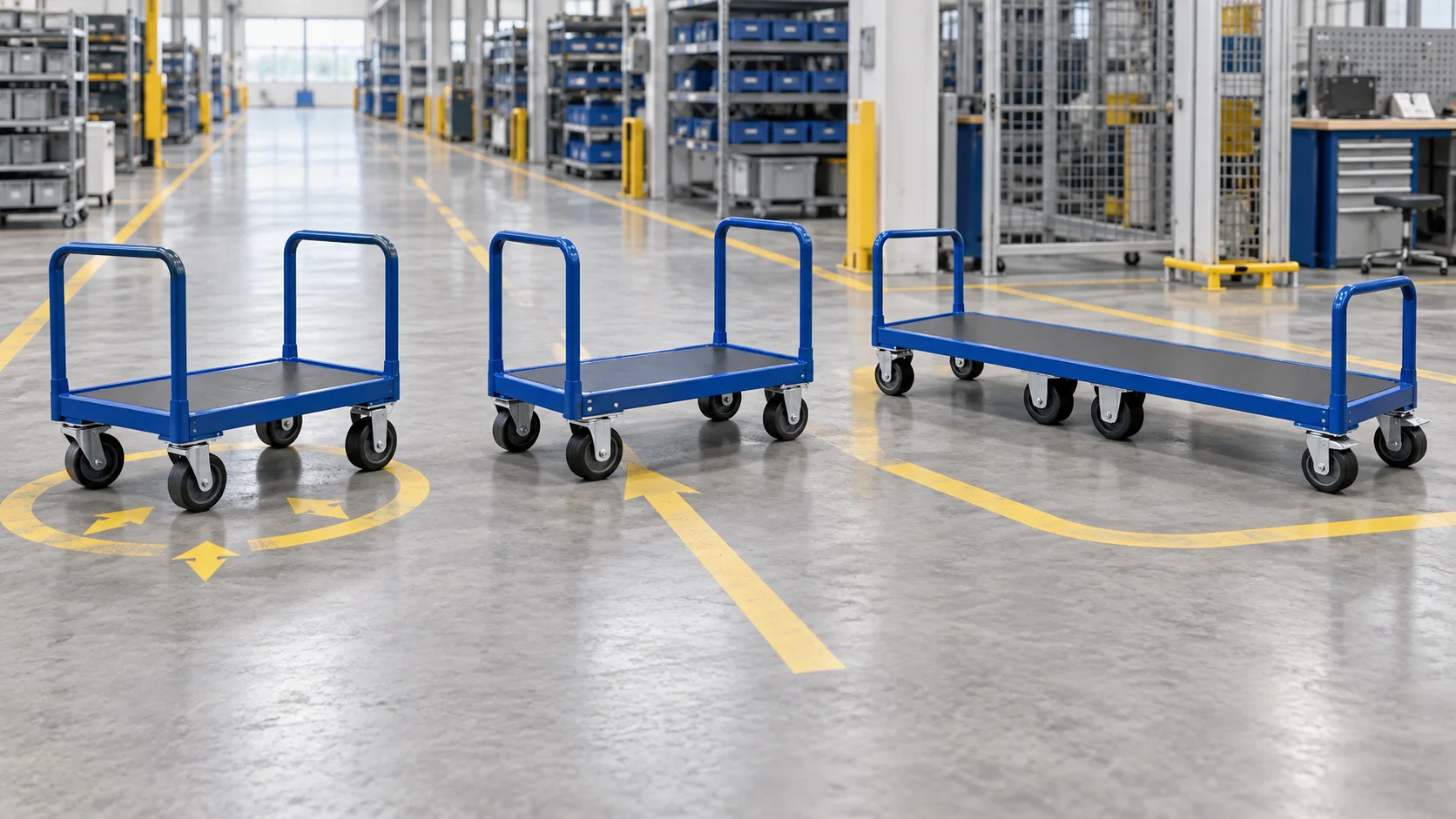
Choose the caster layout from the motions the trolley must make, not from a wheel catalogue. Four swivel casters are a useful starting point for short multidirectional moves and sideways positioning, but they can wander in a long aisle. Two fixed plus two swivel casters create a preferred travel direction and steer from one end. A six-wheel layout with a central fixed pair can help a longer trolley pivot, but it also changes floor contact and stability. Write down straight travel, cornering, reversing, side-shifting, thresholds, slopes, stopping and parking before deciding where each fixed, swivel, braked or directionally locked caster goes.
Good industry references describe the options, but the buyer still needs to connect them to one route. Blickle's manoeuvrability guide compares four-swivel, fixed/swivel and six-wheel arrangements and notes their different straight-line and turning behaviour. Colson's castor combinations explains how two fixed and two swivel casters balance steering and directional travel, while directional locks can make an all-swivel set more versatile. Hamilton's running-gear guide adds the long-truck question with four-swivel/two-rigid arrangements. The useful purchasing decision is the arrangement; wheel compound, diameter, bearings, mounting and component capacity follow from that layout and the real duty.
Start with the required motion, not a default arrangement
| Layout | Useful starting condition | Trade-off to trial |
|---|---|---|
| Four swivel | Short moves, frequent direction changes, side-shifting or precise work-cell positioning. | Wheel alignment at startup and straight-line control on slopes or long aisles. |
| Two fixed + two swivel | A consistent push end, longer straight travel and conventional cornering. | Turning envelope, reversing behaviour and whether sideways placement is required. |
| Four swivel with directional locks | The same trolley needs multidirectional positioning and occasional straight tracking. | Who operates the locks, when they are engaged and whether access stays practical. |
| Four swivel + two central fixed | A longer frame needs directional control and the ability to pivot around a central pair. | Uneven-floor contact, rocking, end swing and stability through the full route. |
Useful for short, multidirectional positioning; add a straight-line strategy when the route includes longer aisles.
A practical starting point for directional aisle travel with steering from a consistent push end.
Can help a longer frame rotate around central fixed wheels, but floor contact and stability need a real route trial.
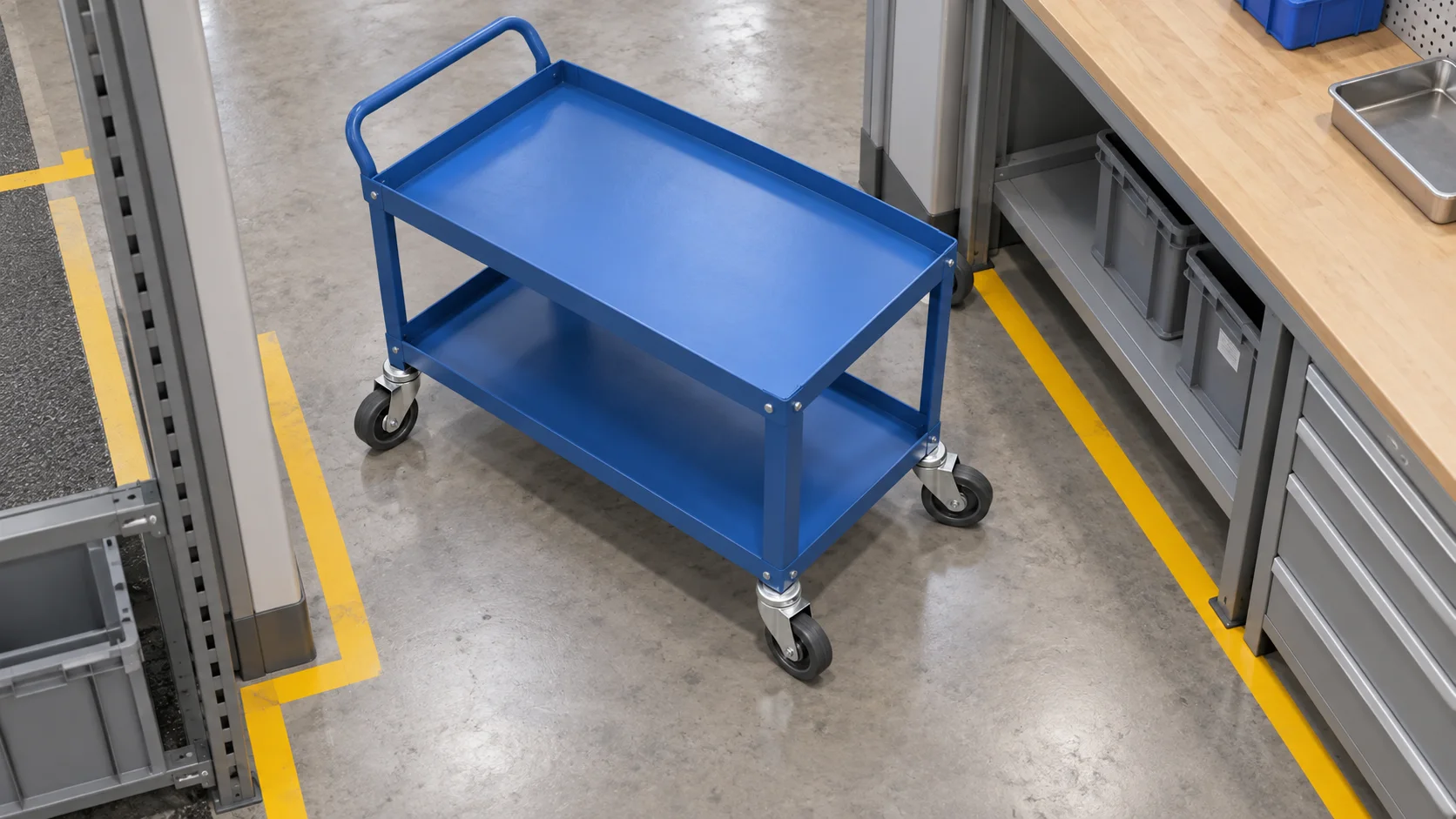
Four swivel casters: easy positioning, less natural tracking
Choose four swivel casters when the trolley must rotate in its own footprint, move sideways beside a fixture or approach the workstation from more than one direction. Draw the complete swivel envelope so the wheel and fork cannot strike the frame, guard, tow interface or operator's feet. If the trolley also travels along a long aisle, compare directional locks on a pair of swivels with a different fixed/swivel layout. A lock is useful only when it is accessible and its operating step fits the route.
Two fixed and two swivel: define the push end and travel direction
A fixed pair keeps the trolley rolling in one plane; the swivel pair changes direction. This makes the arrangement a practical starting point for directional travel, but the handle end, loading orientation and required reverse moves matter. CCOHS's handcart guidance places swivel casters at the handle end for manual carts and highlights poor floors, ramps, starts, stops and direction changes as task inputs. That guidance was last revised in September 2024 and is a useful route checklist—not a HAOFU force limit or approval for a particular trolley.
Walk both the normal and awkward move. A trolley that steers well when pushed forward may be difficult to back out of a workstation, turn through a narrow door or align with a line-side presentation point. If operators regularly swap ends, a single fixed direction may not match the task; four swivels with controlled straight tracking or a purpose-designed steering arrangement may be more suitable.
Six-wheel layouts: useful for long frames, conditional on floor contact
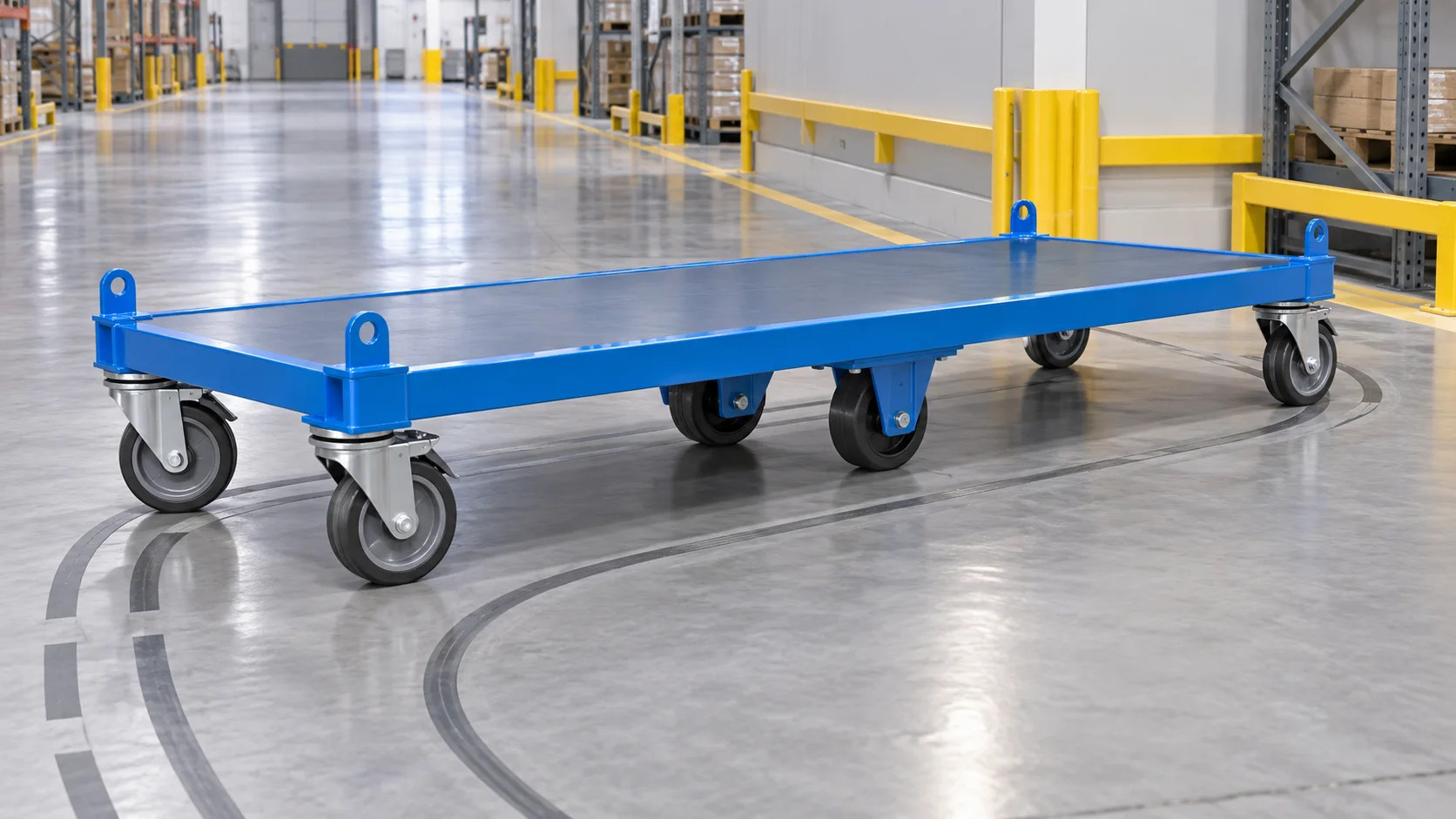
On a long trolley, central fixed wheels can establish a pivot while corner swivels support the ends. The geometry can reduce the space needed to rotate the frame, but it should not be selected from plan view alone. Record the floor flatness, joints and slopes because the intended central-wheel contact affects how the corner wheels share the load. Add load position and centre-of-gravity information, then inspect end swing, rocking and ground contact in the real turn.
Parking and brakes belong to the task map
Mark every place the trolley is left unattended, loaded, unloaded or coupled. A wheel brake, total lock, directional lock and separate floor lock perform different tasks, so specify the required parked state rather than writing only “with brakes.” Show which side the operator can reach, whether a part or panel blocks the pedal, and how the trolley is released before movement. On a slope or a powered-tow route, involve the responsible equipment and site-safety specialists in the operating decision.
ISO 22883:2004, confirmed current in 2022, covers requirements, dimensions and testing for casters and wheels used in manually propelled or power-towed industrial applications up to 1.1 m/s. Use the applicable standard and supplier data when selecting components; it does not choose the trolley layout or establish compatibility for a HAOFU project.
- Write the required movesSeparate straight travel, cornering, side-shifting, reversing and final positioning.
- Mark the route constraintsAdd floor joints, debris, slopes, thresholds, doors, narrow turns and parking points.
- Choose a candidate layoutCompare four swivel, two fixed plus two swivel, directional locks or a six-wheel centre-pivot arrangement.
- Trial the worst moveCheck starting, steering, stopping and parking with the intended load and operators.
Five steps to choose the running-gear layout
- Write the complete motion sequence. Separate straight travel, cornering, side-shifting, reversing, final alignment and parking.
- Measure the difficult route points. Record aisles, turn angles, doors, thresholds, floor joints, debris, slopes and stopping positions.
- Compare candidate arrangements. Review four swivel, two fixed plus two swivel, directional locks and a six-wheel centre-pivot layout against the same route.
- Add component and operator interfaces. Show caster envelopes, mounting plates, handles, brakes, guards, tow equipment and accessible operating positions.
- Trial the worst move. Check start, steer, reverse, stop and park with the intended load, route and users before production release.
What to send for a custom material handling trolley quotation
Send the load drawing, total mass and centre-of-gravity information; trolley envelope; loading and unloading method; normal push end; required straight, turning, side-shift and reverse moves; route drawing; floor joints, thresholds, debris and slopes; stopping and parking points; manual or powered movement state; tow details where applicable; caster and brake preferences if already approved; quantity; and the route-trial task.
Planning a route-specific cart? Review custom material handling trolleys and the narrower industrial rack caster component options, then send the motion map, load and route for an engineering quotation. For connected train geometry, use the tugger swept-path guide; for a manual-to-tow changeover, use the mode-handoff guide; and for broad trolley categories, see the material handling trolley guide.
Frequently Asked Questions
- Is four swivel casters a good trolley layout?
- It is a useful starting point for short multidirectional moves and sideways positioning. For long straight aisles, also compare directional locks or a fixed-and-swivel arrangement to control wandering.
- When should a trolley use two fixed and two swivel casters?
- Use it as a starting point when the trolley has a consistent push end, travels along aisles and turns conventionally. Trial reversing, the tightest turn and final station alignment.
- What does a directional lock do on a swivel caster?
- It prevents the swivel head from rotating while allowing the wheel to roll, temporarily giving the caster a fixed travel direction. The lock position and operating step must remain accessible.
- Why do some long trolleys use six wheels?
- A central fixed pair with swivel corner casters can give a long frame a defined pivot and directional tracking. Floor contact, rocking, end swing and stability still need a route-specific trial.
- Should caster brakes be fitted to every trolley wheel?
- Specify the parked state and operator access first. Wheel brakes, total locks, directional locks and separate floor locks do different jobs, so the number and position depend on the actual task.
- What should I send for a custom trolley quotation?
- Send the load, centre of gravity, trolley envelope, motion sequence, route drawing, turns, thresholds, floor condition, slopes, parking points, manual or tow state, quantity and trial task.