How Many Racks Fit in a 40ft High-Cube? Container Load Planning

To work out racks per 40ft high-cube, divide the container's interior by the rack's shipping footprint and stacked height — a 40ft HC gives about 12.03 m × 2.35 m of floor and 2.69 m of height. Racks that fold or de-post ship far more per container than fixed ones, because empty return volume, not weight, is usually the limit.
How many racks fit in a container decides your freight cost per rack, and freight is a big share of a returnable programme's lifetime cost. Because a sea container is priced as a unit, racks per 40hq container is really the question of how little air you ship. Get the load plan right and each rack lands cheaply; get it wrong and you pay to move empty space across the ocean. This guide shows how to calculate the number and how rack design changes it dramatically.
Quick answer
Divide the container's usable interior by the rack's shipping footprint and its stacked height. A rack that folds flat or has removable posts ships several times more units per container than the same rack fixed, because volume, not weight, is almost always the limit for steel racks.
Know your container's real interior
Start from the interior dimensions, not the nominal name. These are the standard figures behind any load plan:
| Container | Interior L | Interior W | Interior H | Volume |
|---|---|---|---|---|
| 20' standard | 5.90 m | 2.35 m | 2.39 m | ~33 m³ |
| 40' standard | 12.03 m | 2.35 m | 2.39 m | ~67 m³ |
| 40' high-cube | 12.03 m | 2.35 m | 2.69 m | ~76 m³ |
These are the standardised freight-container sizes defined internationally by ISO/TC 104 (the ISO 668 series), so they hold across shipping lines; individual containers vary by a few millimetres. The high-cube's extra 0.30 m of height is exactly why it is the default for racks: that band often buys another layer of folded frames. Door openings are a little smaller than the interior, so always check the rack's largest dimension clears the door.
The method, step by step
- Get the rack's shipping footprint. Its length and width when packed for transport — folded or de-posted, not in use.
- Get the shipping height. One rack's collapsed height, and how many nest or stack within the container height.
- Racks across the width. Interior width (2.35 m) ÷ rack width, rounded down.
- Rows down the length. Interior length (12.03 m) ÷ rack length, rounded down.
- Layers up the height. Interior height (2.69 m for a high-cube) ÷ collapsed stack height, rounded down.
- Multiply. Across × deep × high = racks per container. Leave a little slack for lashing and door clearance.
Why folding changes everything
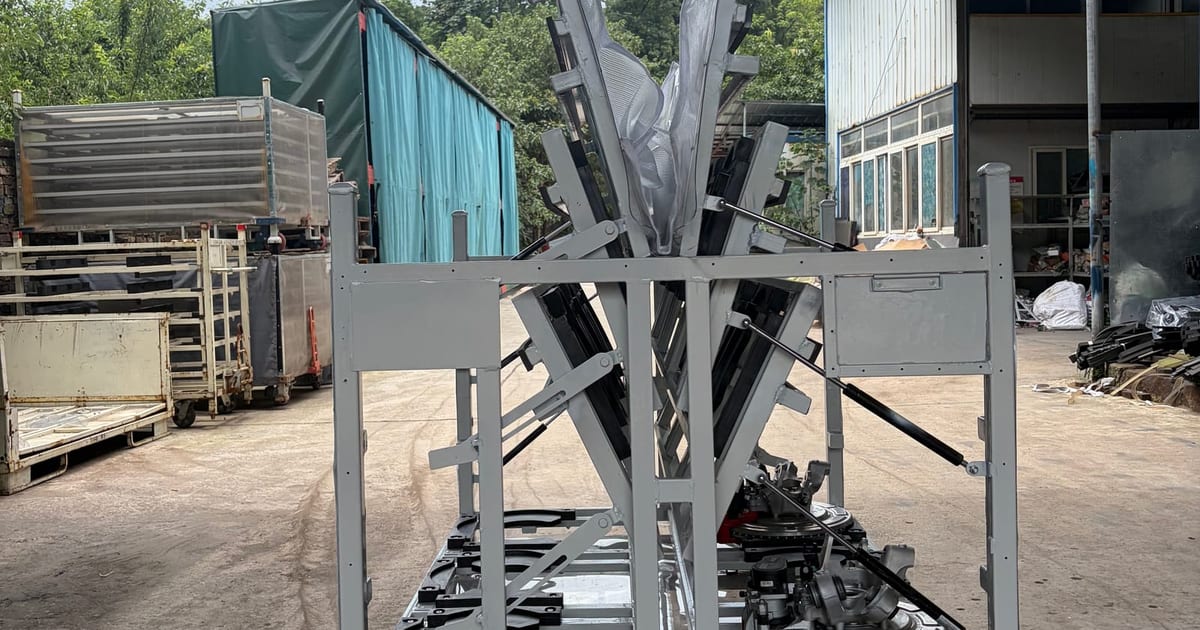
Here is the design decision that dominates the number. A fixed rack ships at its full in-use height, so only one or two layers fit and most of the container is air. The same rack built to remove its posts or fold flat collapses to a fraction of that height, so several layers stack in the same container. It is common for a collapsible design to ship two to four times as many units per container as the fixed version — which cuts inbound freight on the first shipment and return freight on every empty leg after.
This is the same logic that drives pool sizing and cost per trip: empty-return volume is one of the largest recurring costs in a returnable loop, and a rack that ships flat attacks it directly. The lifetime effect is in the cost-per-trip model, and the pool it feeds is in rack pool sizing.
Weight, or volume — which limits you?
A 40ft container has a payload limit as well as a volume limit, but for steel returnable racks you almost always fill the space before you reach the weight ceiling. The exception is very heavy fixed racks shipped in-use; if you are unsure, check the loaded weight against the container payload and your road limits at both ends. When weight is not the constraint, every improvement is about removing air — which means folding, nesting and de-posting.
Common mistakes
- Planning with nominal, not interior, dimensions. The usable box is smaller than the container's name suggests.
- Forgetting the door opening. The interior may be wide enough while the door is not — check the largest rack dimension against the door.
- Shipping racks in-use instead of collapsed. The single most expensive load-planning error for returnable racks.
- Rounding up. A rack that "nearly" fits does not; round every division down and keep clearance for lashing.
- Ignoring the return leg. The empties come back too — a rack that ships flat saves freight in both directions.
Key takeaways
- Racks per container = across × deep × high, using interior dimensions and the collapsed rack.
- A 40ft high-cube gives about 12.03 × 2.35 × 2.69 m — its extra height is why it suits racks.
- Volume, not weight, is almost always the limit for steel racks.
- Folding or de-posting can multiply racks per container two to four times.
- Better container fill cuts freight on both the loaded and the empty leg.
Plan your load with us
Tell us the rack and the lane and we will plan the load. Send us your part, rack footprint and destination and our engineers will design for the best container fill — folded, nested or de-posted — and reply within 24 hours. Start on our customization page, see how collapsible designs work in foldable and collapsible stillage design, and size the fleet that fills those containers in rack pool sizing.
Frequently Asked Questions
- How many racks fit in a 40ft high-cube container?
- Divide the container's interior by the rack's shipping footprint and collapsed stack height: racks across (width ÷ rack width) × rows deep (length ÷ rack length) × layers high (height ÷ stack height). A 40ft high-cube gives about 12.03 m long, 2.35 m wide and 2.69 m high. The exact count depends entirely on the rack size and whether it folds.
- What are the interior dimensions of a 40ft high-cube?
- About 12.03 m long, 2.35 m wide and 2.69 m high, for roughly 76 m³. A standard 40ft is the same length and width but only about 2.39 m high. The high-cube's extra 0.30 m of height is why it is the usual choice for racks — it often buys another layer of folded frames. Door openings are slightly smaller than the interior.
- Do folding racks really fit more per container?
- Yes, substantially. A fixed rack ships at its full in-use height, so only one or two layers fit and most of the container is air. The same rack with removable posts or a folding frame collapses to a fraction of that height, so several layers stack — commonly two to four times as many units per container, which cuts both inbound and empty-return freight.
- Is weight or volume the limit when shipping steel racks?
- Volume, almost always. Steel returnable racks fill the container's space well before they reach its payload limit, so load planning is about removing air — folding, nesting and de-posting. The exception is very heavy fixed racks shipped in use; if in doubt, check the loaded weight against the container payload and the road weight limits at both ends.
- Why plan container loading before ordering racks?
- Because freight is priced by the container, so racks per container sets your shipping cost per rack, and it is driven by the rack's collapsed dimensions — a design decision you make before production. Planning the load first lets you choose a footprint and a folding method that fills the container, which lowers freight on every shipment for the life of the programme.