Removable Post and Height Extension Stacking Racks Explained

Metal stackable racks with removable posts let you pull the corner posts out when the rack is empty so units nest down to a fraction of their working height. Longer posts, or post extensions, raise the same base for taller loads. The trade-off is that every load path now runs through a socket that must be inspected.
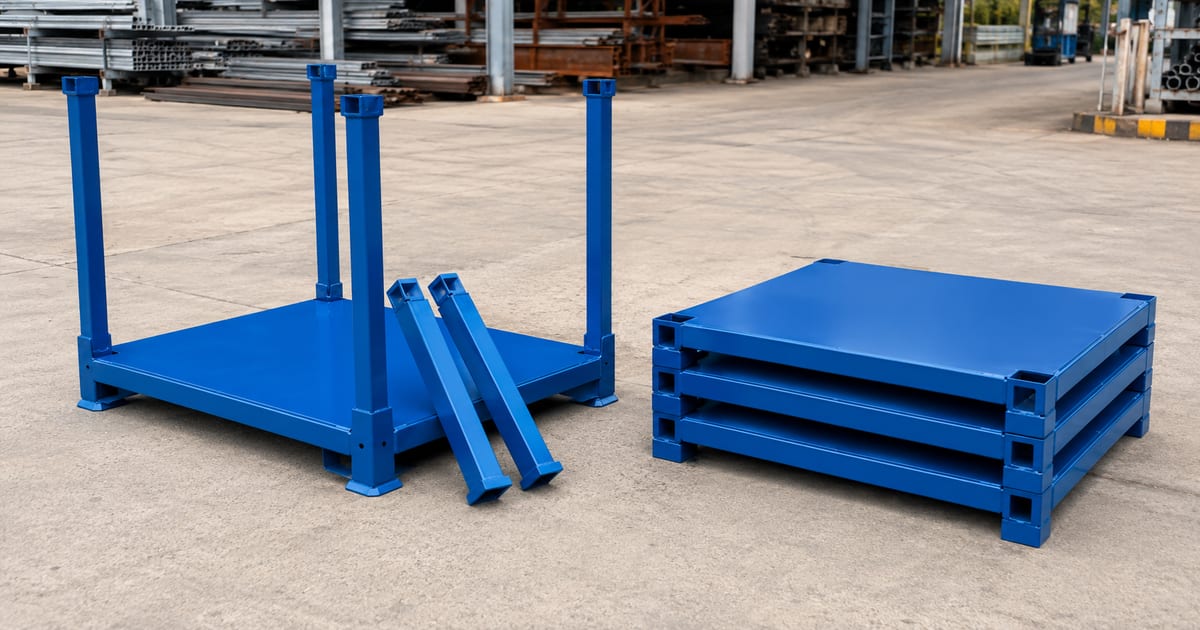
Metal stackable racks with removable posts have corner posts that lift out of sockets in the base when the rack is empty, so units nest down to a fraction of their working height for storage and the return leg. Fit longer posts, or add extensions, and the same base carries a taller load. Both features are useful — and both move the entire load path through a socket joint that has to be designed and inspected properly.
Quick answer: what removable posts actually buy you
- Empty return volume. Posts out, bases nested — several empty racks occupy the space of one erected unit.
- Flexibility. One base serves several part heights by changing post length.
- Damage control. A bent post is a cheap spare, not a scrapped rack.
- Storage. Idle racks stop consuming floor area between programmes.
What they cost you: a joint to maintain, a part that can go missing, and a stacking limit set by the socket rather than the frame.
Why the socket becomes the critical detail
On a welded rack, load runs continuously from the top frame down through the corner into the foot. Make the post removable and that continuous path is interrupted by a sleeve or spigot. The joint now carries compression from every rack stacked above, plus any sideways force from handling, and it does so through a clearance fit that must be loose enough to pull out by hand.
That is why stack limits on removable-post racks are usually set by the joint and not by the steel section. It is also why socket wear — not frame failure — is the normal end-of-life mechanism.
Fixed, removable or foldable?
| Factor | Fixed / welded | Removable post | Foldable |
|---|---|---|---|
| Empty return volume | No reduction | Large reduction once posts are out | Large reduction, nothing detaches |
| Load path | Continuous weld | Through a socket joint | Through hinges and locks |
| Loose parts to manage | None | Posts can be lost or mixed | None |
| Height flexibility | Fixed at build | Change post length or add extensions | Fixed at build |
| Damage repair | Re-weld the frame | Swap a post | Replace hinge parts |
| Inspection focus | Welds | Sockets, spigots, pins | Hinges, latches |
Several established suppliers publish this category as knock-down or demountable post pallets — Vestil and Morrison Industries both describe comparable arrangements — and typical published stack limits sit around four loaded units. Confirm the limit for your own configuration rather than adopting a catalogue figure.
Height extension: when it is safe
Extending height is not simply fitting longer posts. Raising the load raises the centre of gravity, increases the leverage any sideways knock applies to the socket, and changes how the stack behaves during handling and transport. Extension is reasonable when the base, sockets and feet were engineered for the taller case from the start; it is not something to add to an existing fleet without recalculating.
Practically: decide the tallest configuration you will ever run before the first rack is built, then buy short posts for the current job. Growing into a base you already own is cheap. Discovering your base cannot take the taller post is not.
Step-by-step: specifying removable posts
- Fix the load first — weight per rack and how many loaded racks stack.
- Set the tallest future height, and size base, sockets and feet for that case.
- Choose post section and length for today's part, with the socket sized for the future post.
- Specify engagement depth — how far the post seats into the socket is what resists sideways load.
- Decide retention — plain gravity, a detent, or a pin. Pins are more secure and slower to strip.
- Plan post logistics — a bundle rack or a strap so posts return with their bases, and a count at each handover.
- Load-test the sample, including the stacked case, before volume.
Common mistakes
- Treating posts as consumables. They go missing faster than any other rack part; count them like any returnable asset — see rack identification and labelling.
- Ignoring socket wear. A sloppy socket lets the post rock, which accelerates wear and quietly lowers the safe stack height.
- Mixing post lengths in one fleet. Stacks become uneven and operators stop trusting the limit.
- Adding height to an existing base. The base was calculated for the original configuration, not the taller one.
- No visible stack limit. If the safe number is not marked on the rack, it will be exceeded.
Storage-equipment design and inspection guidance is published by bodies including RMI (an MHI group) and FEM in Europe; safe handling follows OSHA materials-handling practice. Reusable transport packaging economics are covered by the Reusable Packaging Association.
Key takeaways
- Removable posts trade a welded load path for a socket joint — the socket usually sets the stack limit.
- Socket wear, not frame failure, is the normal end-of-life mechanism. Inspect it.
- Size the base for the tallest height you will ever run, then buy short posts today.
- Posts are returnable assets. Bundle them, count them, and mark the stack limit on the rack.
Build a rack that collapses the way your loop needs
Read the companion piece on sheet platform decks and how load reaches the posts, or compare collapse methods in our guide to foldable and collapsible stillage design.
See the range on our stackable metal racks page, or send us your load and return route — our engineers will specify the posts, sockets and stack limit and reply within 24 hours.
Frequently Asked Questions
- What are metal stackable racks with removable posts?
- They are stacking racks whose corner posts lift out of sockets in the base when the rack is empty, so the bases nest down to a fraction of their working height for storage and the return leg. Fitting longer posts, or adding extensions, lets the same base carry a taller load.
- How high can removable-post racks be stacked?
- Typical published limits are around four loaded units, but the real limit is set by the socket joint rather than by the steel section, because the post is a clearance fit that must pull out by hand. Confirm the figure for your own configuration and load, and mark it visibly on the rack.
- What usually fails first on a removable-post rack?
- Socket wear, not the frame. Repeated insertion and handling loads gradually open the socket, the post begins to rock, and that rocking accelerates wear and quietly reduces the safe stack height. Sockets, spigots and pins are the inspection priority on this design.
- Can I add height extensions to racks I already own?
- Not without recalculating. Raising the load raises the centre of gravity and increases the leverage any sideways knock applies to the socket, so the base, sockets and feet must have been engineered for the taller case from the start. Decide the tallest configuration before the first rack is built, then buy shorter posts for today's job.
- Removable posts or a foldable rack — which is better?
- Removable posts give a large empty-volume reduction and let one base serve several heights, but the posts are loose parts that can be lost or mixed. Foldable racks collapse with nothing detaching, at the cost of hinges and latches to maintain. Long return legs with varied part heights favour removable posts; high-cycle closed loops often favour foldable.