Stack Height, Load Transfer and Interlock Design in Stacking Racks

A stacking rack's safe height is set by three things working together: how load transfers down through the posts (never through the deck below), how the interlocking feet keep the stack square, and how close the stack gets to its tipping line. A common engineering rule of thumb caps a free-standing stack at roughly three to four times its narrowest base dimension — but the governing limit is whichever of load, interlock or stability runs out first.
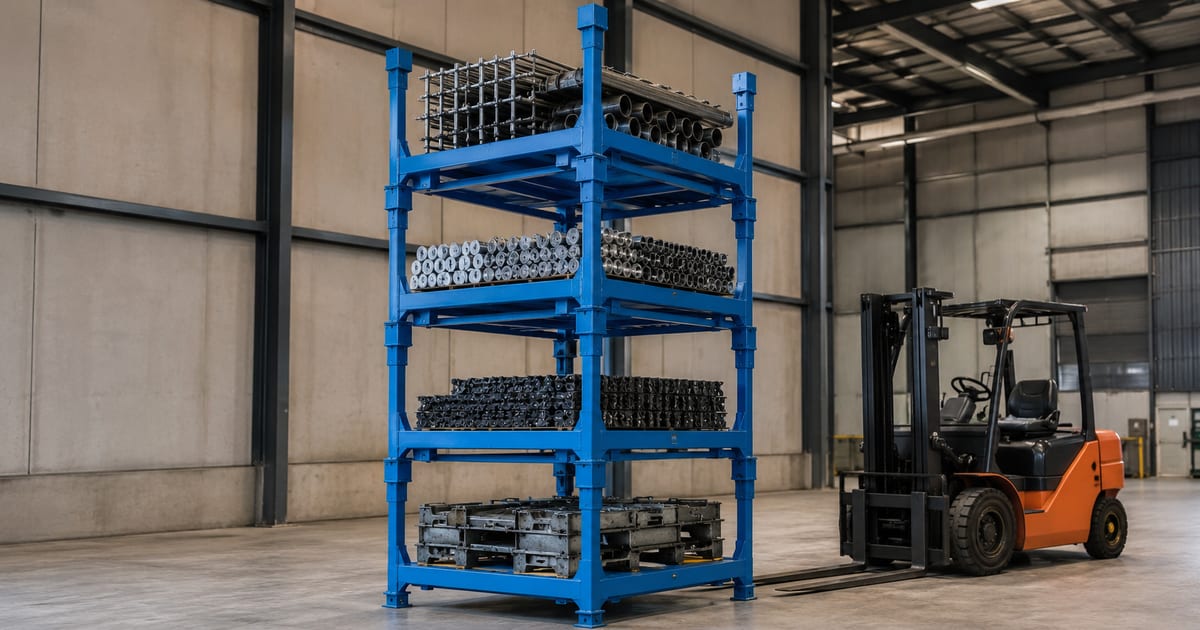
The stack height limit of a stacking rack is not one number pulled from a catalogue — it is the point where whichever of three things runs out first: the load the bottom rack can carry, the interlock that keeps the stack square, or the stability that keeps it from tipping. Get all three right and the rack stacks safely; misjudge any one and the published height becomes meaningless. This guide covers each limit and how to specify for the one that governs your case.
Quick answer: what caps a safe stack
- Load path — the bottom rack carries every rack above it, and that weight must travel down through the corner posts and feet, not through the deck of the unit below.
- Interlock — feet that locate positively into the rack below keep the stack square; without that, units creep and the load goes off-centre.
- Stability — a tall stack has a high centre of gravity, and a common engineering rule of thumb limits a free-standing stack to roughly three to four times its narrowest base dimension.
The safe height is the lowest of the three. A rack rated for heavy load can still be limited by tipping; a stable footprint can still be limited by the post rating.
How load transfers through a stack
Set one loaded rack on another and the entire upper weight lands on the lower rack's corner posts. Those posts pass it into the feet, and the feet pass it into the floor. The deck of the lower rack should never see the weight of the rack above — if it does, the design is wrong and the deck will dish.
This is why the bottom rack in a stack is the one that matters. Its posts carry its own load plus everything above, so a four-high stack sizes the bottom posts for four loads, not one. It is also why an uneven floor is dangerous: a foot that does not land squarely throws its share of the stack onto the other three.
Why interlocking feet matter
Interlock is what turns a pile into a stack. Feet that locate positively — into a cup, a rim or a spigot on the rack below — stop the units sliding relative to each other during handling, transport vibration and minor floor slope. Without positive location a stack can "walk", the centre of gravity drifts toward an edge, and a stack that was stable when built becomes unstable after a forklift nudge.
Good interlock also spreads the effect of a knock. A located stack resists a side load as one column; an unlocated one lets the top rack shift alone, which is exactly how upper units end up on the floor.
The three limits compared
| Limit | Set by | Symptom if exceeded | How to raise it |
|---|---|---|---|
| Load path | Post section, feet and weld quality | Bottom posts buckle; decks dish | Heavier post section; verified stacked rating |
| Interlock | Foot-to-rim engagement geometry | Stack walks or leans; units shift | Deeper, positive location; cups over flat feet |
| Tipping stability | Height vs narrowest base; CoG | Whole stack topples on a side load | Wider base; lower height; floor flatness |
| Floor | Flatness and slab capacity | Uneven foot contact overloads one corner | Level the floor; spread feet; reduce height |
Step-by-step: setting a safe stack height
- Fix the load per rack and the number of racks you want to stack.
- Size the bottom rack — its posts, feet and welds carry the full stack above, with a safety margin.
- Check the tipping line — compare stack height against the narrowest base dimension and keep a margin below the three-to-four-times rule of thumb.
- Specify positive interlock so feet locate, not just rest.
- Confirm the floor is flat enough and strong enough for the loaded footprint.
- Load-test a sample stack, including the top-heavy case, before volume.
- Mark the limit visibly on the rack so it is never exceeded in service.
Common mistakes
- Quoting the height a rack can reach, not the height it is safe at. The safe number is the lowest of the three limits.
- Stacking on an uneven floor. A rocking foot overloads the other three and defeats the interlock.
- Assuming full load allows full height. A heavy load lowers the tipping limit because it raises the centre of gravity.
- Relying on friction instead of interlock. Vibration and handling walk an unlocated stack out of square.
- No load test. Structural design should be validated on a sample, standard practice under a documented quality system such as ISO 9001, which HAOFU operates to.
Storage-rack design and safe stacking are addressed by industry bodies including RMI (an MHI group) and FEM in Europe, and safe stacking practice follows OSHA materials-handling guidance. Treat any height rule of thumb as a starting point, confirmed by calculation and a load test for your configuration.
Key takeaways
- Safe stack height is the lowest of three limits: load path, interlock and tipping.
- The bottom rack carries the whole stack — size its posts for every rack above.
- Positive interlock, not friction, keeps a stack square under handling and vibration.
- Keep a margin below the three-to-four-times-base tipping rule, and mark the limit on the rack.
Specify a stack that holds its limit
Read the companion pieces on sheet platform decks (how load first reaches the posts) and removable post and height extension racks (what changes when posts are demountable). For a full selection walk-through, see our stackable rack buying guide.
See the range on our stackable metal racks page, or send us your load and stack height — our engineers will size the posts, interlock and safe limit and reply within 24 hours.
Frequently Asked Questions
- How high can you safely stack metal racks?
- The safe height is the lowest of three limits: what the bottom rack's posts can carry, how well the feet interlock to keep the stack square, and the tipping line. A common engineering rule of thumb caps a free-standing stack at roughly three to four times its narrowest base dimension, but the real limit must be confirmed by calculation and a load test for your load and configuration.
- How does load transfer through a stack of racks?
- The weight of every rack above lands on the corner posts of the rack below, which pass it into the feet and then the floor. The deck of a lower rack should never carry the rack above it. That is why the bottom rack governs: its posts carry its own load plus everything stacked on top, so a four-high stack sizes the bottom posts for four loads.
- Why do stacking racks need interlocking feet?
- Interlock is what turns a pile into a stack. Feet that locate positively into a cup, rim or spigot on the rack below stop the units sliding during handling, transport vibration and minor floor slope. Without positive location a stack can walk out of square, the centre of gravity drifts to an edge, and a side load can topple it.
- Does a heavier load let me stack higher?
- No — usually the opposite. A heavier load raises the stack's centre of gravity, which lowers the tipping limit. Load rating and stack height are separate constraints, and the safe height is whichever runs out first, so a rack rated for heavy load can still be limited by stability rather than strength.
- What role does the floor play in stack height?
- A large one. An uneven floor means a foot does not land squarely, so its share of the stack is thrown onto the other three corners, overloading them and defeating the interlock. Stack height assumes a flat, adequately strong slab; on a poor floor the safe height drops.