Stackable Rack Buying Guide: Matching Configuration to Your Parts

Choosing a stackable rack means matching four configuration decisions to your parts: the deck (sheet, mesh or open), how it collapses for the empty return (fixed, removable-post or foldable), how high it safely stacks, and how it is handled. Start from the part and the return route, not from a catalogue size.
Choosing a stackable rack is really four decisions, not one: what the deck is made of, how the rack collapses for the empty return leg, how high it safely stacks, and how it is moved. Get those four right for your specific part and your return route and the rack pays back over years; copy a catalogue size and you inherit someone else's compromise. This buying guide walks through each decision and the data a manufacturer needs to quote accurately.
Quick answer: the four decisions
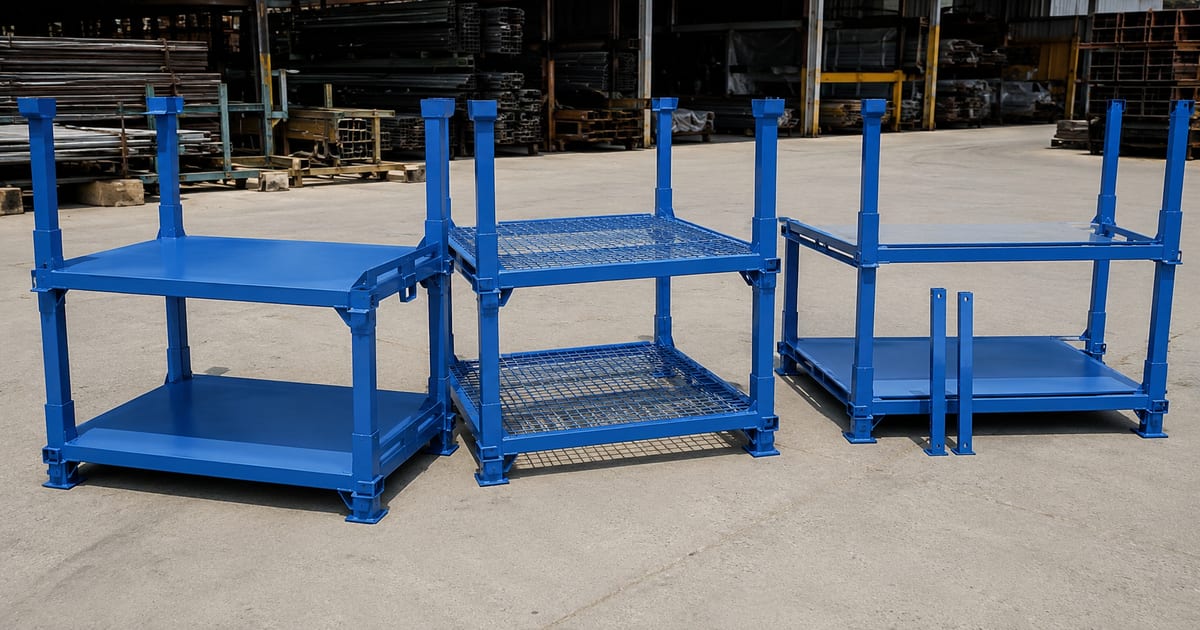
- Deck — solid sheet for small, loose or oily parts; mesh for drainage and visibility; open bar for large rigid parts.
- Collapse method — fixed for short local loops; removable-post or foldable to cut empty return freight.
- Stack height — set by load, interlock and tipping, not by how tall the rack could be built.
- Handling — forklift pockets, pallet-truck entry, casters or a tow bar, matched to how you actually move it.
Every one of these follows from two inputs: the part, and the route the rack travels. Fix those first.
Decision 1 — the deck
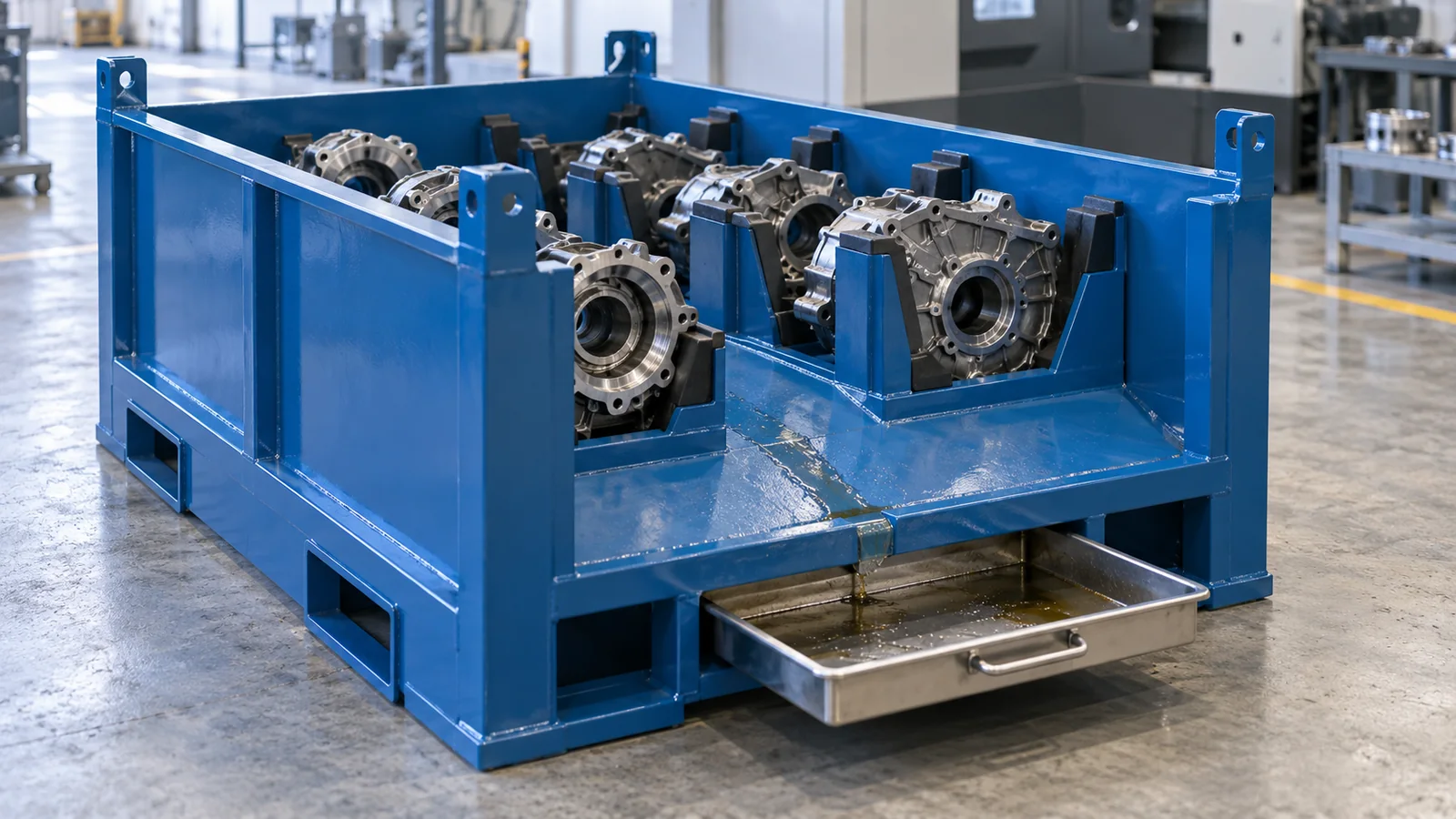
The deck is what the part rests on, and the part decides it. Small, loose, bagged or oily parts need a solid sheet platform; parts that must drain or be counted suit mesh; large rigid parts with known contact points can sit on open bars. This choice also affects tare weight and cleaning. We cover it in depth in our guide to sheet platform decks.
Decision 2 — how it collapses
The return leg decides this. On a short in-plant loop a fixed rack is simplest and strongest. On a long return where empty racks ship back, you want the volume down: removable posts let bases nest, and a foldable frame collapses with nothing to lose. The longer and more expensive the return, the more a collapsible design pays for itself.
Decision 3 — how high it stacks
Stack height is an engineering output, not a preference. It is set by the load the bottom rack carries, the interlock that keeps the stack square, and the tipping line — explained fully in stack height, load transfer and interlock design. Decide the working height you need, then let the manufacturer confirm it is safe rather than assuming it.
Decision 4 — how it is handled
Match the base to how the rack actually moves. Forklift pockets for lift trucks, pallet-truck entry for manual moves, heavy-duty casters with brakes for hand handling, or a tow bar for a tugger train. The wrong base makes a good rack slow to use, and handling method also feeds back into deck and stack decisions.
Configuration by part type
| Your situation | Deck | Collapse | Handling |
|---|---|---|---|
| Small oily machined parts, in-plant loop | Solid sheet | Fixed | Forklift / caster |
| Large panels, long returnable loop | Open bar with supports | Removable post | Forklift |
| Loose components needing drainage | Mesh | Foldable | Pallet truck |
| Line-side feed, mixed parts | Sheet or mesh | Fixed low stack | Tow bar + casters |
Common mistakes
- Buying a catalogue size. A rack built around someone else's part rarely fits yours without waste.
- Ignoring the empty return. A cheap fixed rack can cost more over a year in return freight than a collapsible one saved.
- Over-specifying stack height. Height you never use adds cost and lowers the tipping margin.
- Choosing the deck last. It is the decision most likely to cause part damage if wrong.
- No sample. A load-tested sample before volume is the cheapest insurance against a costly production error.
Reusable transport packaging economics are covered by the Reusable Packaging Association, and safe handling follows OSHA materials-handling practice. For a broader material comparison, our guide to steel vs wooden pallets covers the reuse case.
Key takeaways
- A stackable rack is four decisions — deck, collapse, stack height, handling — not a catalogue size.
- Every decision follows from two inputs: the part and its route.
- The empty return leg often decides whether a collapsible design pays for itself.
- Stack height is engineered, not chosen; confirm it, do not assume it.
Get a configuration matched to your parts
Start with the part. Send us your part drawings, weight and return route and our engineers will propose the deck, collapse method, safe stack height and handling base, and reply within 24 hours. See the range on our stackable metal racks page, or read how the numbers work in stack height and load transfer.
Frequently Asked Questions
- How do I choose the right stackable rack?
- Match four decisions to your parts and return route: the deck (solid sheet for small, loose or oily parts; mesh for drainage; open bar for large rigid parts), the collapse method (fixed, removable-post or foldable), the safe stack height (set by load, interlock and tipping), and the handling base (forklift, pallet truck, casters or tow bar). Start from the part, not from a catalogue size.
- What is the most important decision when buying a stackable rack?
- The two inputs that drive everything are the part and the route the rack travels. Fix those first, then the deck, collapse method, stack height and handling all follow. The single decision most likely to cause part damage if it is wrong is the deck, so do not leave it until last.
- When is a fixed rack better than a collapsible one?
- On a short in-plant loop where empty racks do not travel far, a fixed welded rack is simpler, stronger and cheaper. Collapsible designs — removable posts or foldable frames — pay for themselves when the empty return leg is long or expensive, because they cut the volume shipped back.
- Should I match the rack to the part or buy a standard size?
- Match it to the part. A catalogue size built around someone else's component rarely fits yours without wasted space or inadequate protection. A rack engineered to your part's footprint, weight and contact points carries more per footprint and protects the part better over its life.
- What information does a manufacturer need to quote a stackable rack?
- The part's footprint, weight and contact pattern; how many parts per rack; the load per rack and how many racks stack; the return route (does the empty rack nest, fold or ship as-is); the handling method; and the environment (indoor, outdoor, wash-down or oily). With that, a manufacturer can propose deck, collapse method, stack height and base, and load-test a sample before volume.